
Your situation

Estates over £1m

The sharpest inheritance tax exposure sits above £1m. Planning early is what softens it.

A couple standing on the pavement looking up at a large period house

What is the current makeup of your estate?

Choose as many as apply.

Search to compare financial advisers.

How exposed is your estate?

Inheritance tax planning for estates over £1 million has changed shape. From April 2026, business and agricultural reliefs are capped, and from April 2027 pensions are due to come into the inheritance tax net. Families who were comfortably covered by reliefs a few years ago now face a 40% charge on wealth they assumed would pass intact.

The good news is that the planning tools still work: gifting, trusts, allowances used deliberately, and estates structured with the reliefs that remain. An independent adviser builds that plan around your family rather than around any product, and the introduction through us is free.

Is this you?

  • Your home, pensions and investments add up to more than £1m and nobody has ever shown you the tax bill.
  • You own a business or farmland and want to know what the 2026 relief cap means for your family.
  • You were treating your pension as the inheritance, and the 2027 change has caught you out.
  • You want to start giving money away but do not know how much you can afford to give.

How an independent adviser helps with estate planning

Mapping the real exposure

The first step is an honest number: what the estate is worth across property, business interests, pensions and investments, which allowances and reliefs apply, and what the tax bill would be today. Most families have never seen this laid out.

Gifting with structure

Gifts made seven years before death usually fall out of the estate entirely, and taper relief can reduce the charge from year three. An adviser helps you decide what you can afford to give away without risking your own security, and documents it properly.

Responding to the 2026 and 2027 changes

The £2.5m cap on full business and agricultural relief, and pensions entering the estate from 2027, both reward early action. Restructuring ownership, reviewing wills, and rethinking which assets fund retirement and which pass on are all live decisions now.

Keeping the plan current

Estate planning is not a one-off exercise. Values move, rules change, and families grow. An ongoing advice relationship keeps the plan matched to the rules in force rather than the ones that applied when it was written.
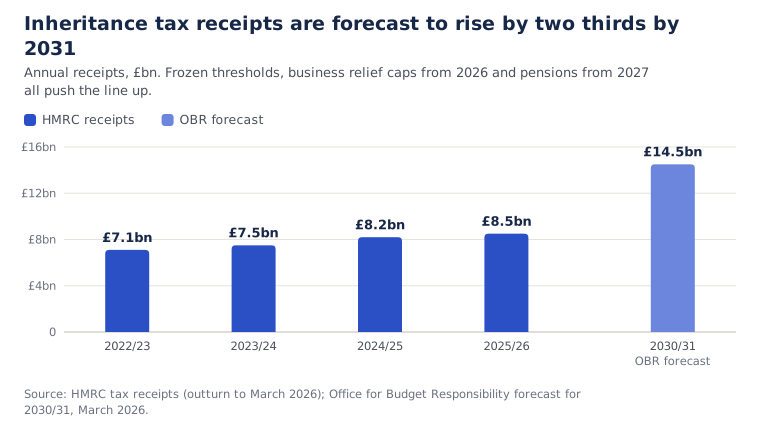
Inheritance tax receipts are forecast to rise by two thirds by 2031
Inheritance tax receipts reached a record £8.5bn in 2025/26 and the OBR expects £14.5bn a year by 2030/31. Frozen thresholds, the business relief cap and pensions entering the estate all push the line up.

What the 2027 change does to one family's bill

Illustrative only and deliberately simplified: a married couple, everything passing to their children on the second death, no gifts made, no business or agricultural assets, both deaths after April 2027.

The estate is £2.4m: the family home at £900,000, pensions of £700,000, ISAs and investments of £600,000 and £200,000 in cash.

Under the rules that applied before April 2027, the pensions sat outside the estate. The taxable estate was £1.7m. The couple's two nil rate bands (£650,000) and two residence nil rate bands (£350,000) covered the first £1m. Tax at 40% on the remaining £700,000: £280,000.

From April 2027 the pensions count. The estate is now £2.4m, and because it is over £2m the residence nil rate band tapers away by £1 for every £2 over the line, cutting it from £350,000 to £150,000. Allowances now total £800,000. Tax at 40% on £1.6m: £640,000.

Same family, same assets. The bill has more than doubled, and the pension the couple thought of as the inheritance has become the reason for it. Where a pension holder dies after 75, the children may also pay income tax on what they draw from it.

The point of the example is not the numbers. It is that this family has options, from how they draw their retirement income to what they give away and when, and every one of them works better started early.

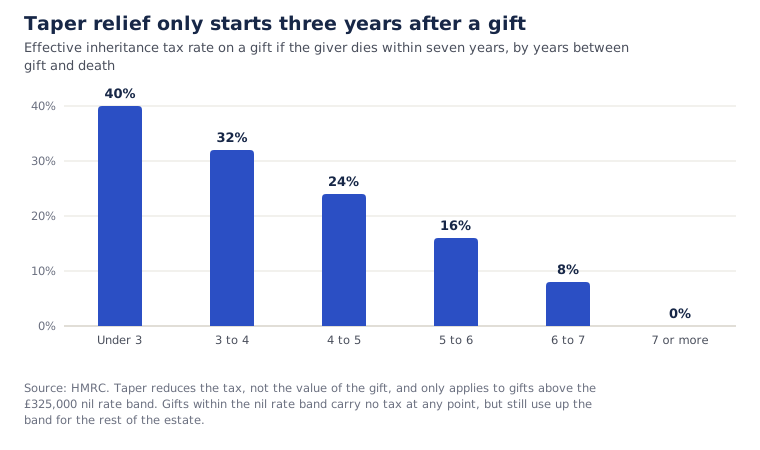
Taper relief only starts three years after a gift
Taper relief only starts three years after a gift, and only on gifts above the £325,000 nil rate band. Within three years the full 40% applies; after seven years the gift is outside the estate.

Key facts for 2026/27

Last reviewed 30 October 2026

What happens when you get in touch

You give us a rough picture of the estate: property, pensions, investments, any business or land, and whether you already have a will and a solicitor. One of our team calls you within a working day. We then introduce you to an adviser experienced in estate planning at your level, usually within a week, and the first meeting is free and without obligation. Where the right first step is a solicitor rather than a financial adviser, we will tell you that on the call.

Find your adviser
★★★★★“Professional but informal: after a ten minute chat I was set up with a financial adviser. Really easy and friendly.” · Graham
★★★★★“They took time to assess my specific needs and match me up with a financial adviser with appropriate expertise.” · David
★★★★★“A personal, tailored service like this is invaluable and very reassuring.” · Louise
★★★★★“Asked the right questions, no pushing particular products, and put me in touch with an independent FCA adviser in my area.” · Lucie
★★★★★“I was quickly assigned to an IFA who helped me more with my pension than I’ve received elsewhere.” · Natalie
★★★★★“Kya took the worry out of finding the right company to work with, and it was all done within 24 hours.” · Ruth
★★★★★“Communication with IFA Connect was first class at all stages, and the local IFA is of high calibre.” · Firghil
★★★★★“Luke put me in touch with a financial adviser who met my needs. Excellent, quick and friendly service.” · Adrian
★★★★★“A great experience. I got connected with the adviser very quickly, thanks!” · Paulina
★★★★★“Luke responded within the day and proposed an IFA. The introductory call went well and we are exploring further.” · Mr Makin
★★★★★“I was put in touch with a local financial adviser and his help has been great thus far.” · Mrs Mclean
★★★★★“Luke was very understanding as I am hard of hearing, and I have a home visit arranged with a financial adviser.” · Arwyn
★★★★★“Great way to find an independent adviser. Highly recommended.” · Glenn
★★★★★“Early days but it seems you have matched me with a suitable IFA. Thanks.” · Margaret

Every adviser passes a seven step vetting process. Every one offers whole of market independent advice. And every introduction is free, with no obligation.

Questions people ask

Is it too late to plan if I am in my seventies?

No. Gifts still leave the estate after seven years, regular gifts from income leave it immediately, and the order in which you spend pensions, ISAs and cash in retirement changes what is left to tax. Life cover written in trust can also pay the bill rather than reduce it. What changes with age is which tools carry the most weight.

Should I take money out of my pension before April 2027?

This is the question advisers are being asked most, and the answer depends on your age, your income tax position, your other assets and your health. The trade is income tax now against inheritance tax later, and for many people the right answer is to change the order they draw from rather than to withdraw a lump sum. An adviser models both routes with your numbers before you do anything.

Do I need a solicitor or a financial adviser?

Usually both, doing different jobs. The solicitor drafts the will, sets up any trusts and deals with the legal side. The adviser works out where the assets should sit, what you can afford to give away, and how the plan holds up over time. They should be talking to each other.

What does the £2.5m business relief cap mean for us?

If your business or farmland is worth more than £2.5m per owner, the excess now gets 50% relief rather than 100%, which means 20% tax on that excess. Where ownership sits, whether the allowance is used across both spouses, and how the business is valued all now matter in a way they did not before April 2026.

Can gifting go wrong?

Yes, in three main ways: giving away money you later need, giving something away while continuing to benefit from it (which HMRC treats as if you had never given it), and not keeping records. An adviser builds the gifting plan around your own security first and documents every gift.

What does estate planning advice cost?

Advisers agree fees with you in writing before starting. A fixed fee for the initial plan is common, with an ongoing charge if they manage investments for you. The FCA-cited averages across all advice are 2.4% initial and 0.8% a year ongoing. IFA Connect's introduction is free to you; advisers pay to be part of our network.

Read next

Find an IFA near you

Our growing network of fully vetted, FCA-regulated advisers spans the UK, ready to help with pensions, tax efficiency, investments and retirement.

Find your local IFA today