
Your situation

Selling your business

Structure the proceeds well and the sale you worked years for keeps working for you.

A business owner standing in his workshop with his arms folded

Where are you in the sale process?

Search to compare financial advisers.

Start planning your exit

Good financial advice when selling a business starts earlier than most owners expect. The decisions that shape your after-tax position, how the deal is structured, when it completes, and what happens to the proceeds, are largely settled by the time heads of terms are signed. An independent adviser working alongside your accountant and solicitor helps you make those calls while they are still open.

The advisers we introduce are FCA regulated, whole of market, and experienced with business exits specifically: owners selling trading companies, partners exiting practices, and founders taking a mix of cash and deferred consideration. The introduction is free and there is no obligation to proceed.

Is this you?

  • You have had an approach for the business, or you are planning to sell within the next one to three years.
  • You are a partner leaving a practice, or a founder taking part of the price as deferred consideration or an earn-out.
  • You have already signed heads of terms and want to know what is still open.
  • You sold recently and the proceeds are sitting in a current account while you work out what to do.

How an independent adviser helps with a sale

Before the sale: structure and timing

Whether you qualify for Business Asset Disposal Relief, how the consideration is split, and which tax year the gain lands in can each move the final bill significantly. An adviser helps you weigh these choices before they are locked into the deal.

Around completion: reliefs and allowances

From BADR and capital gains tax rates to pension contributions in your final trading years, there is a window around completion where allowances can still be used well. Advice here is about sequencing, not products.

After the sale: a plan for the proceeds

A seven-figure bank balance is a starting point, not a plan. An independent adviser builds the after-sale picture: how much you need for income, what sits in which tax wrapper, and how the rest is invested for the long term.

Alongside your other professionals

Your accountant handles the computation and your solicitor the contract. The adviser owns the personal financial plan that the sale feeds into, and coordinates with both so nothing falls between the three.
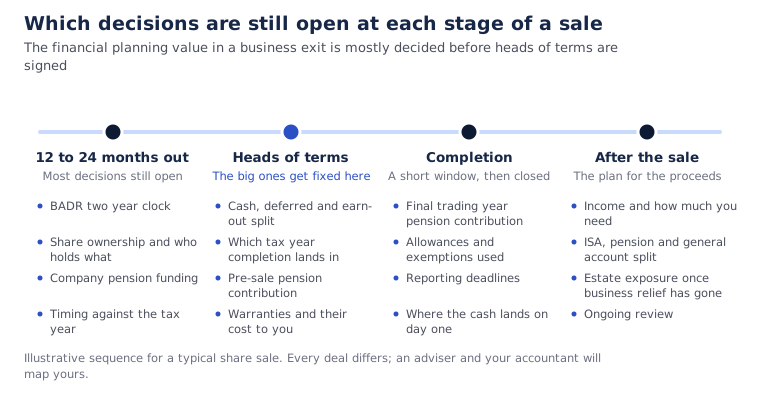
Which decisions are still open at each stage of a business sale
Which decisions are still open at each stage of a sale. The financial planning value in an exit is mostly decided before heads of terms are signed.

What the numbers look like

Illustrative only. Every sale is different and the figures below ignore base cost, costs of sale and any other reliefs.

An owner sells a trading company for £3m in the 2026/27 tax year. She has held the shares for ten years, works in the business, and qualifies for Business Asset Disposal Relief. Her gain, after a modest base cost, is £2.9m.

The first £1m of the gain is taxed at the BADR rate of 18%, which is £180,000. The remaining £1.9m is taxed at 24%, which is £456,000. Total capital gains tax: £636,000, before the £3,000 annual exemption.

Now the questions an adviser would have raised eighteen months earlier. If her husband had held a qualifying stake for two years and worked in the business, his own £1m BADR limit would have applied to his share of the gain, at 18% rather than 24%: a difference of £60,000 on that £1m. If the company had made employer pension contributions in the final trading years, up to £60,000 a year plus up to three years of unused allowance, those sums would have left the company with corporation tax relief rather than being taxed as part of the sale. And the day after completion, around £2.4m of cash has replaced shares that qualified for business relief from inheritance tax, so her estate's exposure has changed overnight.

Timing matters too. For sales on or after 6 April 2027, BADR covers only the first £500,000 of lifetime gains, so the same sale made after that date would cost her £30,000 more.

None of that is a recommendation. It is the list an adviser works through with you while the choices are still open.

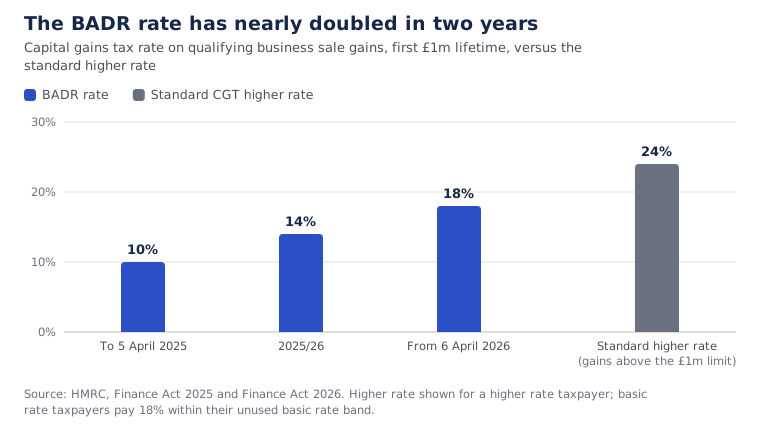
The BADR rate has nearly doubled in two years
The BADR rate has nearly doubled in two years: 10% until April 2025, 14% in 2025/26, 18% from 6 April 2026. Gains above the lifetime limit are taxed at the standard 24% higher rate. The limit is £1m, falling to £500,000 for sales on or after 6 April 2027.

Key facts for 2026/27

Last reviewed 30 October 2026

What happens when you get in touch

You tell us where the sale is, roughly what the business is worth, and whether you have an accountant and solicitor already engaged. One of our team calls you within a working day to go through it properly. We then introduce you to an adviser who has handled exits at your scale, usually within a week, and you meet them with no fee and no commitment. If the sale is further along than we can usefully help with, we will say so on the call.

Find your adviser
★★★★★“Professional but informal: after a ten minute chat I was set up with a financial adviser. Really easy and friendly.” · Graham
★★★★★“They took time to assess my specific needs and match me up with a financial adviser with appropriate expertise.” · David
★★★★★“A personal, tailored service like this is invaluable and very reassuring.” · Louise
★★★★★“Asked the right questions, no pushing particular products, and put me in touch with an independent FCA adviser in my area.” · Lucie
★★★★★“I was quickly assigned to an IFA who helped me more with my pension than I’ve received elsewhere.” · Natalie
★★★★★“Kya took the worry out of finding the right company to work with, and it was all done within 24 hours.” · Ruth
★★★★★“Communication with IFA Connect was first class at all stages, and the local IFA is of high calibre.” · Firghil
★★★★★“Luke put me in touch with a financial adviser who met my needs. Excellent, quick and friendly service.” · Adrian
★★★★★“A great experience. I got connected with the adviser very quickly, thanks!” · Paulina
★★★★★“Luke responded within the day and proposed an IFA. The introductory call went well and we are exploring further.” · Mr Makin
★★★★★“I was put in touch with a local financial adviser and his help has been great thus far.” · Mrs Mclean
★★★★★“Luke was very understanding as I am hard of hearing, and I have a home visit arranged with a financial adviser.” · Arwyn
★★★★★“Great way to find an independent adviser. Highly recommended.” · Glenn
★★★★★“Early days but it seems you have matched me with a suitable IFA. Thanks.” · Margaret

Every adviser passes a seven step vetting process. Every one offers whole of market independent advice. And every introduction is free, with no obligation.

Questions people ask

Is it too late if I have already signed heads of terms?

Not necessarily. Some decisions, like the split between cash and deferred consideration, are hard to reopen. Others, including pension contributions before completion, the timing of completion against the tax year, and everything that happens to the proceeds, are still open. An adviser will tell you quickly which is which.

My accountant is handling the tax. What does an adviser add?

Your accountant computes and reports the gain and advises on the corporate side. The adviser owns your personal plan: what the proceeds need to do for you, which wrappers they go into, how they are invested and drawn. The two work together, and neither replaces the other.

How early is early enough?

Two years before a sale, because the BADR qualifying period and any change to who holds shares both need that long. Twelve months still leaves most decisions open. Three months before completion is late, but the plan for the proceeds is still entirely open.

What happens to deferred consideration and earn-outs?

They can be taxed at a different time, and sometimes at a different rate, from the cash element. The timing of the tax against the timing of the money is one of the things the adviser and accountant look at together.

Does selling change my inheritance tax position?

Usually yes. Shares in a trading company can qualify for business relief from inheritance tax. The cash you receive for them does not. Advisers routinely build the estate plan alongside the sale plan for this reason.

What does the advice cost?

Advisers set their own fees and agree them with you in writing before any work starts. Exit planning is usually priced as a project, with an ongoing charge afterwards if they manage the proceeds. For context, the FCA-cited averages across all advice are 2.4% initial and 0.8% a year ongoing. IFA Connect's introduction is free to you; advisers pay to be part of our network.

Read next

Find an IFA near you

Our growing network of fully vetted, FCA-regulated advisers spans the UK, ready to help with pensions, tax efficiency, investments and retirement.

Find your local IFA today