The inheritance tax threshold for 2026/27 is £325,000 per person. Most people who leave their home to children or grandchildren can add up to £175,000, so a single person can usually pass on £500,000 and a married couple up to £1 million before any tax is due. Above that, the rate is 40%.
The thresholds are frozen until April 2031, and from April 2027 most unused pensions will count too. That is why more families are being caught, often without realising until probate.
Quick answer: The inheritance tax threshold (the nil-rate band) is £325,000 per person in 2026/27. Leaving your home to children or grandchildren adds a residence nil-rate band of up to £175,000, taking the total to £500,000. Married couples and civil partners can pass unused allowances to each other, so up to £1 million. Tax is 40% on the amount above. Both bands are frozen until April 2031.
Key takeaways
- £325,000 is the basic threshold for everyone. It has not changed since 6 April 2009 and is frozen until April 2031.
- £175,000 more (the residence nil-rate band) applies only if your home, or a share of it, goes to children, stepchildren or grandchildren.
- Couples can reach £1 million because whatever the first partner does not use passes to the survivor.
- Over £2 million, the residence band shrinks by £1 for every £2, so a single person's tax rises by 60p for every extra £1 between £2m and £2.35m.
- From 6 April 2027, most unused pension funds count towards the estate, which will push more families over the threshold.
What is the inheritance tax threshold in 2026/27?
Everyone has a tax-free amount called the nil-rate band. In 2026/27 it is £325,000, the same figure that has applied since 6 April 2009. Inheritance tax is charged at 40% only on the part of the estate above your threshold, not on the whole estate.
Some estates also get the residence nil-rate band, worth up to £175,000, when a home passes to direct descendants. The table shows every allowance that sets your threshold.
| Allowance | 2026/27 amount | Who gets it | Frozen until |
|---|---|---|---|
| Nil-rate band | £325,000 | Everyone | April 2031 |
| Residence nil-rate band | Up to £175,000 | Home (or share) left to children, stepchildren, grandchildren or their spouses | April 2031 |
| Total for one person | Up to £500,000 | With a qualifying home | April 2031 |
| Total for a married couple or civil partners | Up to £1,000,000 | Second death, both allowances passed on, home to direct descendants | April 2031 |
| Rate above the threshold | 40% | Value above your threshold | - |
| Reduced rate | 36% | If 10% or more of the net estate goes to charity | - |
Sources: gov.uk Inheritance Tax; HMRC Inheritance Tax thresholds and interest rates (updated 6 April 2026); Budget 2025 (26 November 2025). As at 15 October 2026.
What is the residence nil rate band and how does it work?
The residence nil rate band (RNRB) adds up to £175,000 to your inheritance tax threshold when your home passes to direct descendants. It only applies if your home, or a share of it, is closely inherited. That means it goes to a child, stepchild, adopted or foster child, grandchild or other lineal descendant, or to their spouse or civil partner. Nephews, nieces and siblings do not count.
It is capped at the value of the home you leave. A £120,000 flat gives £120,000 of residence band, not £175,000. If you sold or downsized after 8 July 2015, a downsizing addition may protect some of it.
Our guide to inheritance tax on estates over £1 million covers the reliefs that sit alongside it.
Is the inheritance tax threshold £1 million for married couples?
Yes, if three things line up. Anything left to a spouse or civil partner is exempt, so the first death normally uses none of the allowances. The unused percentage then passes to the survivor, doubling both bands at the second death.
| Single person | Married couple or civil partners | |
|---|---|---|
| Nil-rate band | £325,000 | £650,000 |
| Residence nil-rate band | £175,000 | £350,000 |
| Total tax-free | £500,000 | £1,000,000 |
| Conditions | Home to direct descendants | First estate passes to the spouse; home to direct descendants; estate not over £2m |
Source: gov.uk Inheritance Tax, transfer of unused threshold. Assumes the home is worth at least £175,000 per person.
Inheritance tax on property: does your house count?
Yes. Inheritance tax on property is charged on your share of every home and building you own, less any mortgage. Only one home can also earn the residence nil rate band, and only if you lived in it at some point.
| Property | Counts towards the estate? | Can it get the residence nil rate band? |
|---|---|---|
| Main home left to children or grandchildren | Yes, value less mortgage | Yes, up to £175,000 |
| Main home left to anyone else (niece, friend, sibling) | Yes | No |
| Jointly owned home | Your share only | Yes, on your share, if it goes to direct descendants |
| Second home you have lived in | Yes | Only if nominated as the one qualifying home |
| Buy-to-let you never lived in | Yes | No |
| Home sold or downsized after 8 July 2015 | The money or assets it became | Possibly, through the downsizing addition |
Sources: HMRC Inheritance Tax Manual IHTM46011 (qualifying residential interest); gov.uk residence nil rate band guidance. As at 15 October 2026.
If the estate has more than one home that qualifies, the executors choose which one to nominate.
What happens to the inheritance tax threshold over £2 million?
The residence nil-rate band shrinks by £1 for every £2 the estate is worth above £2 million. A single person loses it completely at £2.35 million, and a couple's double band disappears at £2.7 million.
That creates a hidden 60% rate. Between £2 million and £2.35 million, each extra £1 in a single person's estate costs 40p in tax and 50p of allowance, which is another 20p of tax.
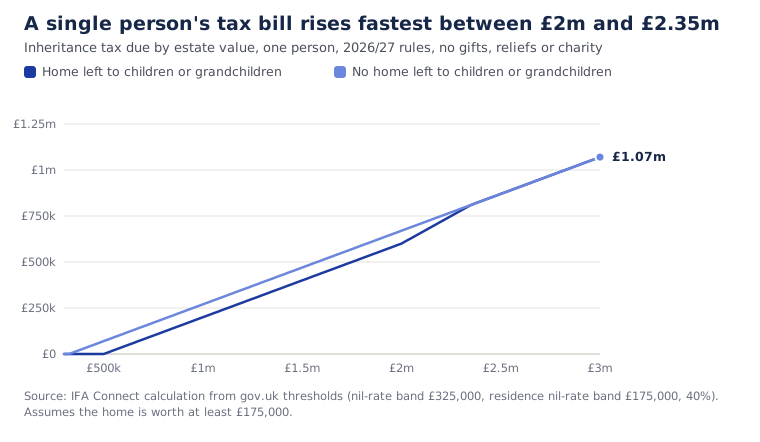
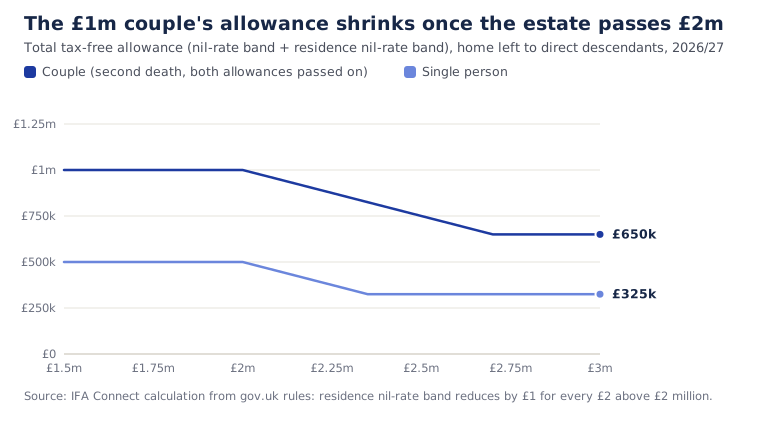
Lifetime gifts can bring an estate back under £2 million, but from April 2027 most unused pensions will count towards it. An adviser can show what is worth doing for you, and our estates over £1m page explains how IFA Connect can introduce one.
Inheritance tax calculator: how much would your family pay?
Use these five worked examples as a quick inheritance tax calculator. They use 2026/27 rules, assume no lifetime gifts, no other reliefs and a home worth at least the residence band claimed. Each calculation was run in code from the HMRC thresholds.
| Example | Nil-rate band | Residence band | Total threshold | Taxable | Tax at 40% |
|---|---|---|---|---|---|
| Single, no home to children: £450,000 estate, left to a niece | £325,000 | £0 | £325,000 | £125,000 | £50,000 |
| Single, home to children: £600,000 estate incl. £300,000 home, left to children | £325,000 | £175,000 | £500,000 | £100,000 | £40,000 |
| Widow(er), both allowances: £900,000 estate incl. home, left to children | £650,000 | £350,000 | £1,000,000 | £0 | £0 |
| Single, estate over £2m: £2.2m estate incl. home, left to children | £325,000 | £75,000 | £400,000 | £1,800,000 | £720,000 |
| Widow(er), estate over £2m: £2.5m estate incl. home, left to children | £650,000 | £100,000 | £750,000 | £1,750,000 | £700,000 |
IFA Connect calculation from gov.uk thresholds. Illustrative only; real estates may qualify for other reliefs or exemptions.
The jump between the third and fourth rows is the taper at work. At £2.2 million, a single person keeps only £75,000 of the residence band. The widow(er) at £2.5 million keeps £100,000 of a possible £350,000.
Inheritance tax on gifts: do gifts use up the threshold?
Yes. Inheritance tax on gifts works like this: gifts made in the seven years before death are added back and use the £325,000 nil-rate band first, before the rest of the estate. Many gifts are exempt straight away, and these never count.
| Exempt gift | Limit | Notes |
|---|---|---|
| Annual exemption | £3,000 a tax year | Unused amount can be carried forward one year |
| Small gifts | £250 per person | Not to someone who has had your annual exemption |
| Wedding or civil partnership | £5,000 child; £2,500 grandchild; £1,000 anyone else | Given on or shortly before the day |
| Normal expenditure out of income | No set limit | Regular, from income, and leaves your standard of living intact |
| Spouse or civil partner | Unlimited | Capped at £325,000 if the receiving spouse is not UK long-term resident |
| Charity | Unlimited | Also unlocks the 36% rate at 10% of the net estate |
Source: gov.uk Inheritance Tax: gifts. As at 15 October 2026.
Larger gifts that are not exempt become tax-free after seven years. If the giver dies sooner and the gifts total more than £325,000, taper relief cuts the tax on the excess.
| Years between gift and death | Less than 3 | 3 to 4 | 4 to 5 | 5 to 6 | 6 to 7 | 7 or more |
|---|---|---|---|---|---|---|
| Tax rate on the gift | 40% | 32% | 24% | 16% | 8% | 0% |
Source: gov.uk Inheritance Tax: gifts. Taper relief only applies when gifts in the seven years before death exceed the £325,000 threshold.
See the seven-year gifting rule for how to record gifts so your executors can prove them.
What is changing for inheritance tax in 2026 and 2027?
| Date | Change | Who it affects |
|---|---|---|
| 6 April 2026 | 100% business and agricultural property relief limited to a £2.5m allowance per person (transferable to a spouse); 50% relief above it. AIM shares get 50% relief in all cases | Business owners, farmers, AIM shareholders |
| 6 April 2027 | Most unused pension funds and death benefits counted in the estate; executors report and pay | Anyone with a defined contribution pension they may not spend |
| To April 2031 | £325,000 and £175,000 thresholds stay frozen | Every estate, as asset values rise |
Sources: gov.uk APR and BPR changes (updated 3 March 2026); gov.uk Inheritance Tax on unused pension funds and death benefits (26 November 2025); Budget 2025.
The pension change is the big one for many families. A £400,000 pension that sits outside the estate today could add £160,000 of tax from April 2027 if the rest of the estate already uses the threshold and it is not left to a spouse or civil partner, who remain exempt. Read pensions and inheritance tax from 2027 for the detail, and business relief changes in 2026 if you own a company.
How many estates actually pay inheritance tax?
Fewer than one in 20. HMRC's latest figures show 4.72% of UK deaths, about 30,400, led to an inheritance tax charge in 2023/24, raising £7.03 billion. The average bill was £231,000.
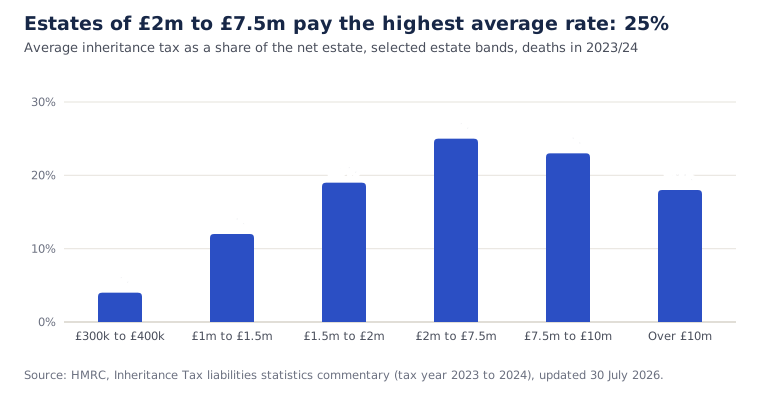
The rate peaks in the £2 million to £7.5 million band, where the taper removes the residence band. Above £10 million it falls again, as larger estates use more reliefs and planning.
How to avoid inheritance tax legally: 8 common ways
You can legally reduce or avoid inheritance tax by using the exemptions and allowances HMRC already gives you. These are the eight most common ways families do it, with the catch for each.
| # | Way to reduce inheritance tax | How it helps | Watch out for |
|---|---|---|---|
| 1 | Leave assets to your spouse or civil partner | No tax at the first death; unused allowances pass on | Defers the bill to the second death |
| 2 | Leave your home to children or grandchildren | Unlocks up to £175,000 more | Lost above £2.35m (single) or £2.7m (couple) |
| 3 | Use the £3,000 annual exemption and £250 small gifts | Leaves the estate immediately | Limits reset each tax year |
| 4 | Give regularly from surplus income | No limit and exempt straight away | Must be regular and leave your lifestyle intact; keep records |
| 5 | Make larger gifts and live seven years | Fully outside the estate after seven years | Tax can fall due if you die sooner |
| 6 | Leave 10% or more to charity | Rate falls from 40% to 36% | Based on the net estate |
| 7 | Put assets into a trust | Future growth can sit outside the estate | 20% charge above £325,000 going in; charges every 10 years |
| 8 | Life insurance written in trust | Pays the bill outside the estate | Premiums rise with age and health |
Sources: gov.uk Inheritance Tax: gifts; gov.uk Trusts and Inheritance Tax; gov.uk Inheritance Tax. General information, not a recommendation.
Which of these fit depends on your income, health, family and how much you need to live on. See trusts and family wealth for how the main trust types are taxed, and speak to an adviser before moving large sums.
Who pays inheritance tax, and when is it due?
- The executor (or administrator) values the estate and works out what is owed.
- Some tax is usually paid before the grant of probate is issued.
- The rest is due by the end of the sixth month after the death. A death in January means payment by 31 July.
- HMRC charges interest on late payment, currently 7.75%.
- Tax on property can often be paid in yearly instalments over 10 years, with interest.
If you are an executor dealing with an inheritance now, our inheritance or windfall page explains how an adviser can help.
When should you speak to an independent financial adviser?
The inheritance tax threshold itself is simple. Planning around it is not, and getting it wrong can cost your family 40% of the excess. It is worth taking advice if any of these apply:
- Your estate, including your home and pensions, is close to or above £500,000, or £1 million as a couple.
- Your estate is over £2 million, or could pass that line once pensions count from April 2027.
- You want to give money to children or grandchildren and keep enough for yourself.
- You own a business, farmland or AIM shares.
- You are thinking about trusts or life insurance to cover the bill.
IFA Connect does not give advice. A real person listens to your situation and introduces you to one independent, FCA-regulated adviser from advisers we have interviewed and vetted. See how we vet our advisers. We typically introduce people with £250,000 or more in investable assets.
Find your local IFA: a real person matches you with one vetted, independent adviser. Our introduction is free; advisers explain their fees before you commit.
Frequently asked questions
What is the inheritance tax threshold for 2026/27?
The threshold is £325,000 per person. If you leave your home to children or grandchildren, you can add up to £175,000 more, a total of £500,000. Tax is charged at 40% on the value above your threshold, or 36% if you leave at least 10% of the net estate to charity.
Is the inheritance tax threshold £1 million for a married couple?
It can be. Each partner has £325,000 plus up to £175,000 for the home. Anything the first partner leaves to their spouse or civil partner is exempt, and the unused allowance passes to the survivor. If the home then goes to direct descendants, the survivor's estate can pass on up to £1 million tax-free, provided it is worth no more than £2 million.
When will the inheritance tax threshold go up?
Not before April 2031. The Budget on 26 November 2025 froze the £325,000 nil-rate band and the £175,000 residence nil-rate band until then. As house prices and savings grow, more estates will cross the threshold.
Does my house count towards the inheritance tax threshold?
Yes. Your home is part of your estate, along with savings, investments and possessions, less debts such as a mortgage. Leaving the home to direct descendants also unlocks the extra £175,000 residence nil-rate band, capped at the home's value.
Do gifts count towards the inheritance tax threshold?
Gifts made in the seven years before death can use up the £325,000 threshold first. Small and regular gifts are exempt, such as the £3,000 annual exemption and gifts out of surplus income. If you live seven years after a gift, it normally falls outside your estate.
Will my pension count towards inheritance tax?
From 6 April 2027, most unused pension funds and death benefits will be counted as part of your estate for inheritance tax. Death-in-service benefits are excluded. Before then, most defined contribution pensions are usually outside the estate.
How can I avoid inheritance tax legally?
The main legal ways are leaving assets to a spouse or civil partner, leaving your home to direct descendants, using the yearly gift exemptions, giving from surplus income, making gifts you survive by seven years, leaving 10% to charity, trusts, and life insurance written in trust. Each has limits, so get advice before moving large sums.
How is inheritance tax charged on property?
Property counts at its value on the date of death, less any mortgage. Only your share of a jointly owned home counts. One home you have lived in can also qualify for the residence nil rate band of up to £175,000 if it goes to direct descendants.
Who pays inheritance tax and when is it due?
The executors or administrators pay it from the estate. It is due by the end of the sixth month after the death, and HMRC charges interest after that, currently 7.75%. Some tax on property can be paid in yearly instalments over 10 years.
Tax rules can change and their effect depends on your circumstances. The Financial Conduct Authority does not regulate tax planning, trusts or will writing.