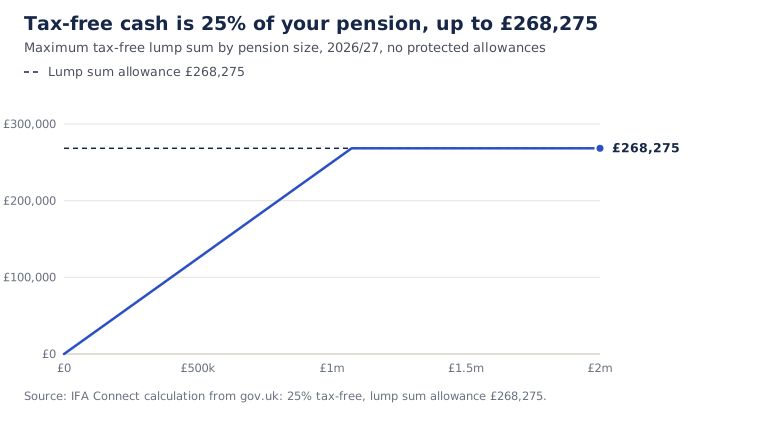
The tax-free pension lump sum is usually 25% of what you have saved, up to £268,275. It is often the first thing people take when they reach 55, and one of the easiest places to make an expensive mistake.
This guide covers how much you can take, when, the two ways to take it, and how the other 75% is taxed, with worked examples in 2026/27 figures.
Quick answer: You can usually take 25% of your pension as a tax-free lump sum, up to a lifetime maximum of £268,275 (the lump sum allowance). You can take it from age 55, rising to 57 from 6 April 2028. Take it all at once, or in stages so 25% of each withdrawal is tax-free. The other 75% is taxed as part of your income for the year.
Key takeaways
- 25% tax-free, capped at £268,275. The cap bites once your pensions are worth more than £1,073,100 in total.
- Age 55 now, 57 from 6 April 2028. The State Pension age is separate: 66, rising to 67.
- All at once or in stages. Stage it (UFPLS or phased drawdown) and 25% of every withdrawal is tax-free.
- Taking only the tax-free cash keeps your £60,000 annual allowance. Taking flexible income (UFPLS or drawdown income) cuts it to £10,000 (the MPAA).
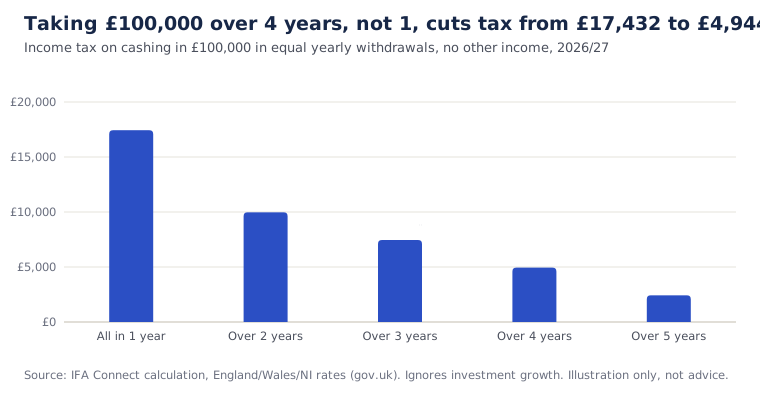
- Spreading withdrawals can save thousands. With no other income, £100,000 cashed in one year costs £17,432 in tax; over four years, £4,944.
How much of my pension can I take tax-free?
You can usually take 25% of each pension tax-free. All your tax-free lump sums together are capped by the lump sum allowance of £268,275, so the 25% rule stops adding up once your pensions pass £1,073,100.
| Total pension savings | Maximum tax-free cash | Left to take as taxable income | Cap reached? |
|---|---|---|---|
| £100,000 | £25,000 | £75,000 | No |
| £250,000 | £62,500 | £187,500 | No |
| £500,000 | £125,000 | £375,000 | No |
| £750,000 | £187,500 | £562,500 | No |
| £1,073,100 | £268,275 | £804,825 | Yes |
| £1,500,000 | £268,275 | £1,231,725 | Yes |
IFA Connect calculation from gov.uk: 25% tax-free, lump sum allowance £268,275, 2026/27. Assumes no protected allowance and no tax-free cash already taken.
What is the maximum tax-free lump sum?
For most people it is £268,275. This lump sum allowance replaced the lifetime allowance, which was abolished from 6 April 2024. A second limit, the lump sum and death benefit allowance of £1,073,100, covers tax-free lump sums paid in your lifetime and on your death together.
| Allowance | 2026/27 amount | What it limits |
|---|---|---|
| Lump sum allowance | £268,275 | All tax-free cash you take in your lifetime |
| Lump sum and death benefit allowance | £1,073,100 | Tax-free lump sums in life plus certain lump sums paid on death |
| Protected allowances | Higher, if you hold one | Fixed, individual or enhanced protection from the old lifetime allowance |
Source: gov.uk, Find out the rules around individual lump sum allowances (updated 29 May 2024); Tax when you get a pension: tax-free part. As at 15 October 2026.
If you took pension benefits before April 2024, your allowance is usually reduced by 25% of the lifetime allowance you used. A transitional certificate can correct this if you took less.
When can I take my tax-free lump sum?
You can usually take your tax-free lump sum from age 55. The normal minimum pension age rises to 57 on 6 April 2028. From then, anyone under 57 has to wait unless their scheme has a protected pension age. That includes people who are 55 or 56 on that date but have not yet taken any money.
This is separate from the State Pension, which starts at 66 and is rising to 67 between 2026 and 2028. Final salary (defined benefit) schemes usually let you swap some yearly pension for a lump sum at a set rate, so ask the scheme for its figures.
How to take your tax-free cash: all at once or in stages
There are two main ways to take your tax-free cash from a defined contribution pension, plus the option of buying an annuity. The choice changes your tax and what you can pay in later.
| Option | How it works | Tax-free part | Triggers the £10,000 MPAA? |
|---|---|---|---|
| Take it all up front (pension commencement lump sum) | Take up to 25% in one go; the rest moves into drawdown or buys an annuity | Up to 25% now | No, unless you also take drawdown income |
| Take it in stages (UFPLS) | Each withdrawal is a separate lump sum from money not yet accessed | 25% of each withdrawal | Yes, from the first withdrawal |
| Phased drawdown | Move part of the pot into drawdown at a time, taking 25% of that part tax-free | 25% of each part moved | Only when you take taxable income |
| Buy an annuity | Take up to 25% tax-free, then use the rest to buy a guaranteed income | Up to 25% at the start | No, for a lifetime annuity that cannot fall |
Sources: HMRC Pensions Tax Manual PTM063300 (UFPLS), PTM056520 and PTM056530 (MPAA triggers). General information, not a recommendation.
Taking everything as one cash lump sum is also possible, but 75% of it is taxed as income in that year. In 2025/26, 45.8% of pension pots accessed for the first time were cashed in fully.
How much tax will I pay on the rest of my pension?
The 75% that is not tax-free is added to your other income for the year and taxed at your income tax rates. Spreading withdrawals over several tax years keeps more of it in the lower bands.
| 2026/27 band (England, Wales, Northern Ireland) | Taxable income | Rate |
|---|---|---|
| Personal allowance | Up to £12,570 | 0% |
| Basic rate | £12,571 to £50,270 | 20% |
| Higher rate | £50,271 to £125,140 | 40% |
| Additional rate | Over £125,140 | 45% |
Source: gov.uk Income Tax rates and Personal Allowances. The personal allowance falls by £1 for every £2 of income over £100,000. Scotland has different bands.
This example shows the effect for someone with no other income cashing in a £100,000 pension, taking 25% of each withdrawal tax-free.
| How it is taken | Withdrawal each year | Tax-free each year | Taxable each year | Total tax paid |
|---|---|---|---|---|
| All in one year | £100,000 | £25,000 | £75,000 | £17,432 |
| Over 2 years | £50,000 | £12,500 | £37,500 | £9,972 |
| Over 3 years | £33,333 | £8,333 | £25,000 | £7,458 |
| Over 4 years | £25,000 | £6,250 | £18,750 | £4,944 |
| Over 5 years | £20,000 | £5,000 | £15,000 | £2,430 |
IFA Connect calculation at 2026/27 rates, England/Wales/NI, no other income, ignoring investment growth and charges. Illustration only.
Other income changes the picture. Someone earning £40,000 who takes £20,000 as a UFPLS pays about £3,946 extra tax, because £4,730 of the taxable £15,000 falls into the 40% band. If your income is near £100,000, also read the 60% tax trap.
Why was I emergency taxed on my pension withdrawal?
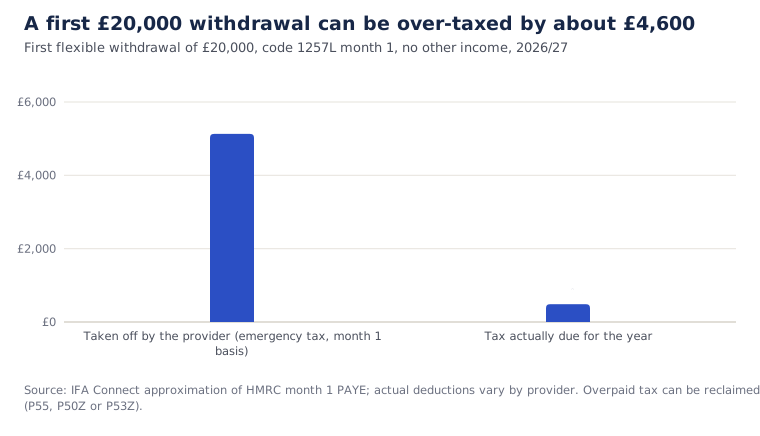
Your pension provider usually has no tax code for you when you make your first flexible withdrawal, so it uses an emergency code on a month 1 basis. That treats the payment as if you will be paid the same every month, which can take far more tax than you owe.
| Your situation | Form to reclaim the overpaid tax |
|---|---|
| You took part of your pension and will not take more this tax year | P55 |
| You took all of your pension, have stopped work and have no other taxable income or benefits | P50Z |
| You took all of your pension and have other income (work, another pension such as a final salary pension, or taxable benefits) | P53Z |
Source: gov.uk, Claim a tax refund on your pension by post (updated 1 October 2026); HMRC PAYE76170. You can also wait for HMRC to correct it after the tax year ends.
Can I keep paying into my pension after taking tax-free cash?
Yes. Taking only your tax-free lump sum leaves your annual allowance as it was. Taking flexible income, through a UFPLS or drawdown income, triggers the money purchase annual allowance (MPAA), which caps future contributions to defined contribution pensions at £10,000 a year.
You also cannot plan to take tax-free cash and pay it straight back in for extra tax relief. The recycling rule applies when the lump sums in a 12-month period exceed £7,500 and contributions rise by more than 30% of the lump sum as a planned result.
Will my pension be taxed when I die?
From 6 April 2027, most unused pension money will count towards your estate for inheritance tax, with your executors reporting and paying it. Pension left to a spouse or civil partner is still exempt. Read pensions and inheritance tax from 2027 before deciding how much to leave invested.
Is the 25% tax-free lump sum being scrapped?
No. Neither the Budget on 26 November 2025 nor the one on 28 October 2026 changed it, and gov.uk still shows the 25% rule and the £268,275 cap, which stays the same for 2027/28. Speculation before each Budget has led some people to take their tax-free cash early and then pay tax on what they did with it, so act on your plan, not on rumour.
How many pension pots are accessed each year?
| Year to 31 March 2026 | Figure |
|---|---|
| Pension pots accessed for the first time | 1,047,008 (up 7.4%) |
| Share fully cashed in | 45.8% |
| Drawdown plans where a tax-free lump sum was taken | 64.5% |
| New drawdown plans | 401,137 |
| Annuities bought | 100,144 |
| Total withdrawn from pensions | £91.2 billion (up 21.7%) |
Source: FCA, Retirement income market data 2025/26 (published 24 September 2026).
When should you speak to an independent financial adviser?
Taking your tax-free pension lump sum is a one-off decision on most of your pension, and some choices cannot be undone. It is worth taking advice if:
- Your pensions are worth more than about £250,000, or close to the £1,073,100 point where the cap applies.
- You still want to pay into a pension and need to avoid triggering the MPAA.
- You have several pensions, including a final salary scheme. See our pension review page.
- You are weighing the lump sum against leaving money invested for your family after April 2027.
- You are not sure how much you need overall: start with how much do I need to retire.
Pension Wise from MoneyHelper offers free, impartial guidance if you are 50 or over with a defined contribution pension. For a personal recommendation you need a regulated adviser.
IFA Connect does not give advice. A real person learns what you need and introduces you to one independent, FCA-regulated adviser. How we vet our advisers · Retirement advice.
We typically introduce people with £250,000 or more in investable assets.
Find your local IFA: a real person matches you with one vetted, independent adviser. Our introduction is free; advisers explain their fees before you commit.
Frequently asked questions
How much of my pension can I take tax-free?
Usually 25% of each pension, up to a total of £268,275 across all your pensions (the lump sum allowance). A £400,000 pension gives up to £100,000 tax-free. Some people have a higher protected amount from before April 2024.
What is the maximum tax-free lump sum from a pension?
£268,275 in 2026/27 for most people. It is reached when your pensions total £1,073,100. If you hold a protected allowance from the old lifetime allowance rules, your limit may be higher.
When can I take my tax-free lump sum?
From age 55 for most personal and workplace pensions, rising to 57 from 6 April 2028. Some schemes have a protected lower pension age. Your State Pension age is separate.
Do I have to take all my tax-free cash at once?
No. You can take it all when you first access the pension, or take it in stages. With an uncrystallised funds pension lump sum (UFPLS), 25% of each withdrawal is tax-free and 75% is taxed as income.
Can I take tax-free cash from more than one pension?
Yes. Each pension usually pays up to 25% tax-free, but all your tax-free lump sums together count towards the one £268,275 lump sum allowance.
Can I keep paying into my pension after taking tax-free cash?
Yes. Taking only your tax-free lump sum does not reduce your annual allowance. Taking flexible income through drawdown or a UFPLS triggers the money purchase annual allowance, which limits future contributions to £10,000 a year.
Why was I emergency taxed on my pension withdrawal?
Providers often use an emergency tax code on a month 1 basis for the first flexible withdrawal, which can take far too much tax. You can reclaim it from HMRC using form P55, P50Z or P53Z, or wait for it to be corrected after the tax year.
Is the 25% tax-free lump sum being scrapped?
No. The Budgets on 26 November 2025 and 28 October 2026 left it unchanged, and gov.uk still shows the 25% rule and the £268,275 cap, which stays the same for 2027/28. Rules can change, so check before you act.
Tax rules can change and their effect depends on your circumstances. The value of investments can go down as well as up, and you may get back less than you put in.