What are the benefits of using a financial adviser? UK research and client surveys point to a handful of consistent benefits, from higher average wealth and better use of tax allowances to peace of mind. They also point to real trade-offs: advice costs money, it is harder to access with smaller savings, and it does not guarantee results.
This guide sets out what the evidence says, who paid for each study, and the costs and limits to weigh up. It is information, not a recommendation.
Quick answer: The main benefits people report from using a financial adviser are a personal plan, help using tax allowances, peace of mind, and regulatory protection. One UK study found people who took advice had, on average, £47,706 more wealth a decade later than similar unadvised people (ILC-UK, 2019). But advice costs money, often 0.5% to 1% a year, and results are not guaranteed.
Key takeaways
- Advice is a personal recommendation. A regulated adviser looks at your circumstances and is responsible for the advice being suitable for you.
- Some studies link advice to higher wealth. People who took advice in 2001-06 had on average £47,706 more a decade later (ILC-UK, with Royal London). This shows an association, not proof that advice caused it.
- Most clients say they value it. 93% of people who paid for advice found it helpful (the lang cat, 2025), and 88% of Aviva's surveyed advice clients reported peace of mind.
- Fees add up. In our illustration, a 1% yearly fee reduces £100,000 growing at 5% a year by about £46,000 over 20 years.
- Access is narrowing. The share of advisers taking on new clients with under £50,000 fell from 52% in 2019 to 25% in 2025 (Schroders).
What are the benefits of using a financial adviser?
The benefits that come up most often in UK research fall into six groups. The table shows each one, what it means in practice, and the evidence behind it.
| Benefit | What it means | What the evidence says |
|---|---|---|
| A personal recommendation | Advice based on your income, goals, tax position and attitude to risk | Only regulated advice gives a personal recommendation; guidance does not (FCA) |
| Higher average wealth | Investing more, and investing differently, over time | Advised people had on average £47,706 more wealth about a decade later (ILC-UK 2019, with Royal London) |
| Using tax allowances | Pensions, ISAs, capital gains and inheritance tax planning | Allowances are set by the government; advisers commonly review how they are used |
| Peace of mind | Less worry about money decisions | 88% of Aviva's surveyed advice clients reported peace of mind (2025) |
| Avoiding costly mistakes | A second view before big, hard-to-reverse decisions | 87% of Aviva's surveyed advice clients said advice was value for money (2025); no survey can show which mistakes were avoided |
| Regulatory protection | A route to complain, and possible compensation, if advice is unsuitable | Financial Ombudsman Service and FSCS can apply to regulated advice |
Sources as listed in each row. Client surveys are self-reported and were funded by firms in the advice industry.
Does financial advice make people better off?
Some UK studies found advised people had higher average wealth, with important caveats. The best-known come from the International Longevity Centre UK (ILC-UK), carried out with Royal London, using the ONS Wealth and Assets Survey.
- 2017 study: people who took advice between 2001 and 2007 were on average around £40,000 better off by 2012-14: £43,245 for the affluent group and £39,895 for the group described as "just getting by".
- 2019 study: people who took advice between 2001 and 2006 had on average £47,706 more in pension and other financial wealth by 2014-16, compared with similar people who were not advised.
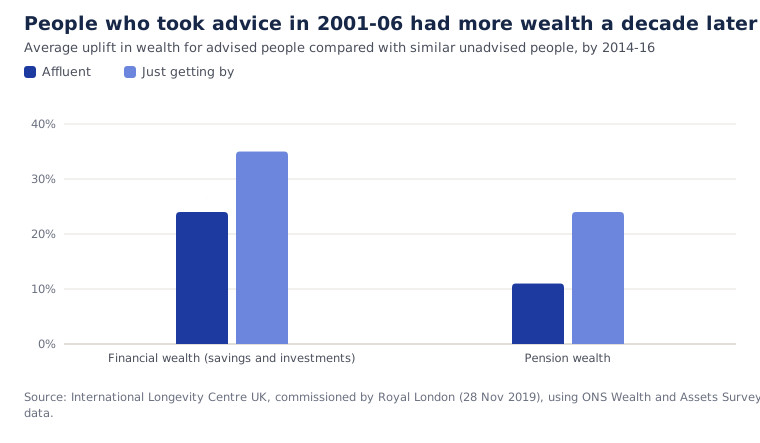
The 2019 study found the uplift was proportionally larger for people with less money: 35% more financial wealth and 24% more pension wealth for the "just getting by" group, against 24% and 11% for the affluent group.
What the research cannot tell you
Read these figures with care. The studies were carried out with a pension provider, use advice given 20 or more years ago, and show an association, not proof that advice caused the difference. People who choose advice may differ in ways a survey cannot fully measure.
Not every study finds a big gap. A 2023 Nucleus survey of over 2,200 savers by YouGov found advised people scored their retirement confidence 7.0 out of 10, against 6.8 for people without advice.
Vanguard estimates that advisers following its framework "can add around 3%" in net returns. This is a modelled estimate over an unspecified period, published by a fund manager, not a measured outcome for UK clients.
What do people who use an adviser say?
Most people who pay for advice say they value it. These surveys ask clients for their own views, so they measure satisfaction rather than outcomes.
| Survey | Finding | Who ran it |
|---|---|---|
| The lang cat, Advice Gap 2025 | 93% of people who paid for advice in the last two years found it very or fairly helpful | YouGov, 2,045 GB adults, 8-9 April 2025; sponsored by AJ Bell Touch, Just Group, Quilter and Royal London |
| Royal London, November 2025 | 68% of people who pay for advice rated it good or excellent value for money, up from 53% three years earlier | Opinium, 2,000 adults, October 2025 |
| Aviva, July 2025 | 87% said advice was value for money (74% in 2021); 80% said it improved their wellbeing (70% in 2021) | Censuswide, about 2,000 adults; answers from advised clients with an ongoing adviser relationship |
Sources: the lang cat Advice Gap 2025; Royal London press release, 18 Nov 2025; Aviva news release, 17 Jul 2025.
Only a minority use advice. The lang cat found 9% of adults paid for financial advice in the last two years. Asked what would put them off, 31% of adults said advice is too expensive, 24% cited a lack of trust in advisers and 24% were unsure where to find a good adviser. More widely, the FCA's Financial Lives 2024 survey found 39% of all UK adults have confidence in the financial services industry.
How advisers work with tax allowances in 2026/27
A large part of financial planning involves tax allowances, which change often. The table shows the main ones for the 2026/27 tax year and the changes already announced. Allowances work the same way whether or not you use an adviser.
| Area | 2026/27 allowance or rule | What is changing |
|---|---|---|
| ISAs | £20,000 a year across all ISAs | The £20,000 limit stays from 6 April 2027, cash ISAs included: Budget 2026 dropped the planned £12,000 cash ISA cap |
| Pension contributions | £60,000 annual allowance; £10,000 if you have flexibly accessed a pension (MPAA) | Tapered for threshold income over £200,000 and adjusted income over £260,000 |
| Capital gains tax | £3,000 tax-free each year | - |
| Dividends | £500 tax-free; rates of 10.75%, 35.75% and 39.35% above that | Rates rose by 2 points on 6 April 2026 |
| Savings interest | £1,000 (basic rate), £500 (higher rate), £0 (additional rate) | From 6 April 2027, tax rates on savings interest rise to 24%, 44% and 49% (Budget 2026) |
| Inheritance tax | £325,000 threshold, plus up to £175,000 when a home passes to children or grandchildren | From 6 April 2027, most unused pensions will count towards the estate (death-in-service benefits are excluded) |
Sources: gov.uk pages on ISAs, pension annual allowance, capital gains tax, dividends, savings interest and inheritance tax (checked 21 Oct 2026); Finance Act 2026 (Royal Assent 18 March 2026) on pensions and inheritance tax; Budget 2026 rates and allowances (28 October 2026) on savings tax rates; HMRC's tax-free savings newsletter, October 2026 on the cash ISA limit.
For more detail, see our guides to pensions and inheritance tax from April 2027, capital gains tax in 2026/27 and the 60% tax trap over £100,000.
What are the downsides of using a financial adviser?
The same research that shows the benefits also shows the costs and limits. These are the main ones to weigh up.
1. Advice costs money, and fees compound
Many advisers charge an initial fee and an ongoing fee, often 0.5% to 1% a year of the money they look after. Over long periods, a yearly percentage fee makes a noticeable difference to the final value.
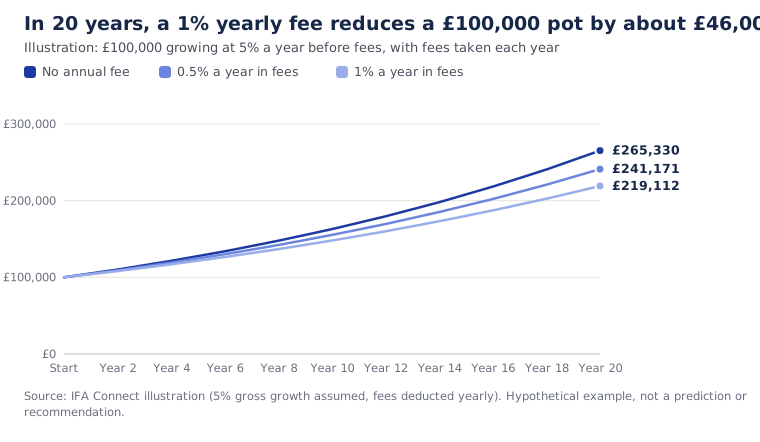
| Yearly fee | Value after 10 years | Value after 20 years | Difference at 20 years |
|---|---|---|---|
| None | £162,889 | £265,330 | - |
| 0.5% | £155,297 | £241,171 | £24,159 less |
| 1% | £148,024 | £219,112 | £46,218 less |
IFA Connect illustration: £100,000 growing at 5% a year before fees, with the fee deducted from growth each year (equivalent to net growth of 4.5% and 4% a year). Hypothetical, not a forecast. Returns are not guaranteed, and product and platform charges apply with or without an adviser.
Whether a fee is worth paying depends on what the advice achieves for you, which no illustration can show. Advisers must tell you their charges, in pounds and pence where possible, before you commit. Our page on financial adviser fees sets out the typical charges.
2. Ongoing service does not always happen
In February 2025, the FCA reviewed 22 large advice firms covering seven years of data. Firms said they had delivered around 83% of the ongoing reviews clients paid for. In about 15% of cases the client declined or did not respond, and in under 2% the firm made no attempt. The FCA asked firms to consider whether redress was due. About 4 million clients pay for ongoing advice.
3. Advice is harder to get with smaller savings
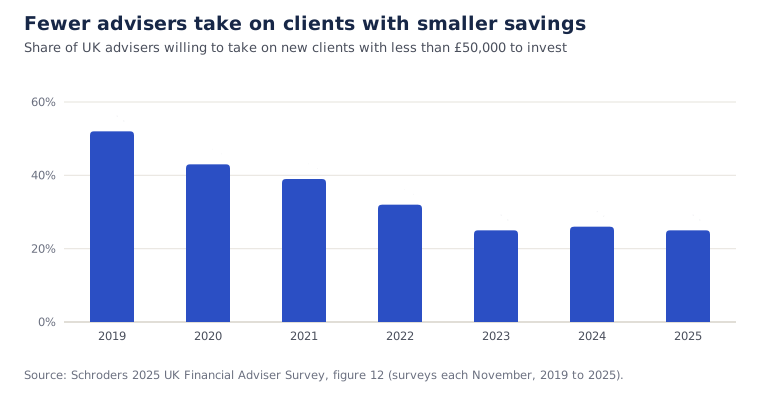
Schroders' adviser surveys found the share of advisers willing to take on new clients with less than £50,000 fell from 52% in 2019 to 25% in 2025. In its 2025 survey, 30% of advisers set a minimum of £200,000 or more.
4. Advice can be wrong
Regulation reduces the risk but does not remove it. When the FCA reviewed advice given to members of the British Steel Pension Scheme, it found that 46% of all transfers were unsuitable, and a redress scheme followed in February 2023. This is why the right to complain matters.
Benefits and limitations at a glance
| Benefit | Matching limitation |
|---|---|
| A personal recommendation for your circumstances | Costs more than guidance, which is free |
| Associated with higher average wealth | Studies show association, not cause, and use older data |
| Help with tax allowances | Fees reduce the money left invested |
| Peace of mind and a second view | Satisfaction surveys are self-reported and industry-funded |
| Ongoing reviews as rules change | The FCA found some paid-for reviews were not delivered |
| Complaint and compensation routes | Advice can still be unsuitable |
Summary of the sources in this guide. Information only, not a recommendation.
Questions people ask before choosing an adviser
People weighing up the benefits often ask advisers these questions. The answers help compare one firm with another.
- What will the advice cost in pounds, both at the start and each year?
- What ongoing service is included, and how often will it happen?
- Are you independent or restricted?
- Is the firm on the FCA Financial Services Register, with permission for the advice I need?
- Do you have a minimum investment level?
Our guide to whether you need a financial adviser covers when advice is required by law, the free alternatives and how to check an adviser. Read more about independent vs restricted financial advice.
How IFA Connect can help
If you decide you want advice, IFA Connect can introduce you to one independent, FCA-regulated adviser. IFA Connect does not give advice itself. A real person listens to what you need and matches you with an adviser from those we have interviewed and vetted. The adviser is responsible for the advice they give you, and our checks do not guarantee the outcome of any advice. See how we vet our advisers.
We typically introduce people with £250,000 or more in investable assets.
Find your local IFA: a real person matches you with one vetted, independent adviser. Our introduction is free; advisers explain their fees before you commit.
Frequently asked questions
What are the benefits of using a financial adviser?
The benefits people most often report are a personal financial plan, help using tax allowances such as ISAs and pensions, peace of mind, and avoiding costly mistakes. Regulated advice also comes with the right to complain to the Financial Ombudsman Service. Research links advice to higher wealth, but it cannot prove advice caused it, and fees reduce returns.
Are people who use a financial adviser better off?
Some UK studies found advised people had higher average wealth. The International Longevity Centre UK, in research with Royal London, found people who took advice in 2001-06 had £47,706 more pension and financial wealth about a decade later than similar people who did not. This is an association in older data, not proof that advice caused the difference.
What are the disadvantages of using a financial adviser?
The main disadvantages are cost, minimum investment levels, and the risk of poor advice. Ongoing fees of 0.5% to 1% a year reduce investment growth over time. Many advisers set minimums: Schroders found only 25% of advisers would take on new clients with under £50,000 in 2025. Advice can also be unsuitable, which is why regulation and complaint routes exist.
Can a financial adviser help me pay less tax?
Advisers commonly review how people use tax allowances, such as the £20,000 ISA allowance, the £60,000 pension annual allowance and the £3,000 capital gains tax exemption. Whether that reduces your tax depends on your circumstances. HMRC's rules apply in the same way whether or not you use an adviser.
Is ongoing financial advice worth the fee?
It depends on the service you receive. In a 2025 review of 22 large firms, the FCA found around 83% of the ongoing reviews clients paid for had been delivered. In about 15% of cases the client declined or did not respond. The FCA asked firms to consider whether redress was due. Firms must tell you what ongoing service you get and what it costs.
Do financial advisers guarantee better returns?
No. Advice does not guarantee returns, and the value of investments can fall as well as rise. Studies that show higher wealth among advised people measure averages, and part of the difference may come from who chooses to take advice.
How much money do I need to benefit from a financial adviser?
There is no legal minimum, but many advice firms set their own. Schroders' surveys found the share of advisers taking on new clients with less than £50,000 fell from 52% in 2019 to 25% in 2025 (the latest published figure for this measure). Free guidance from MoneyHelper and Pension Wise is available whatever your savings.
What protection do I get from regulated financial advice?
If advice from an FCA-regulated firm is unsuitable, you can complain to the firm and then to the Financial Ombudsman Service. If the firm has failed, the Financial Services Compensation Scheme may pay compensation for bad investment or pension advice, up to £85,000 per person per firm. Free guidance and doing it yourself do not give you the same protection.
IFA Connect's introduction service is not covered by the Financial Ombudsman Service or the FSCS.