Independent vs restricted advice is one of the first things to understand when looking for a financial adviser. Both are regulated by the Financial Conduct Authority (FCA). The difference is how wide a range of products the adviser can recommend, and the adviser must tell you which they are before giving advice.
This guide explains what the FCA rules say, what you must be told, how many firms offer each type of advice, and how to check an adviser. It is information, not a recommendation.
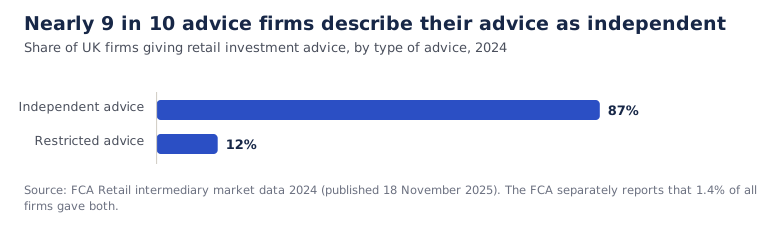
Quick answer: Independent advisers must consider a sufficient range of products from across the market, not limited to their own or linked providers. Restricted advisers recommend from a limited range of products or providers. Both are regulated by the FCA, must give suitable advice and must tell you which they are before advising. In 2024, 87% of firms giving retail investment advice gave independent advice (FCA).
Key takeaways
- The difference is the range of products. Independent advice must be based on a sufficient range of products across the market. Restricted advice is limited to certain products or providers.
- Both are regulated. Independent and restricted advice can only be given by FCA-authorised firms or their appointed representatives, must be suitable for you, and is covered by the Consumer Duty.
- You must be told. Before giving advice, a firm must say whether its advice is independent or restricted, and a restricted firm must explain the nature of the restriction.
- Most firms are independent. In 2024, 87% of firms giving retail investment advice gave independent advice and 12% gave restricted advice (FCA).
- Protection is the same. You can complain to the Financial Ombudsman Service either way, and the FSCS can pay up to £85,000 per eligible person, per firm, for bad investment advice if the firm has failed.
What is the difference between independent and restricted advice?
The key difference is the range of products an adviser can recommend. Everything else, from regulation to complaint rights, is broadly the same. The table compares the two.
| Feature | Independent advice | Restricted advice | FCA rule |
|---|---|---|---|
| Products the adviser can recommend | A sufficient range across the market, not limited to its own or linked providers | A limited range of products or providers, or certain types of product only | COBS 6.2B.11R; Glossary |
| Can the firm specialise? | Yes, in a stated area, if it markets only to clients who want that focus | Yes | COBS 6.2B.15R-16G |
| Can it use panels or platforms? | Yes, if the range still meets the independence rule; the firm stays responsible | Yes | COBS 6.2B.24R-28G |
| What you must be told | That the advice is independent, and why it qualifies | That the advice is restricted, and the nature of the restriction | COBS 6.2B.33R-38R |
| Advice must be suitable for you | Yes | Yes | COBS 9 / 9A |
| Consumer Duty applies | Yes | Yes | PRIN 2A (from 31 July 2023; 31 July 2024 for closed products) |
| Financial Ombudsman Service and FSCS | Yes | Yes | FOS; FSCS |
| Share of retail investment advice firms (2024) | 87% | 12% | FCA market data |
Sources: FCA Handbook COBS 6.2B and Glossary (accessed 21 Oct 2026); FCA PS22/9 (Consumer Duty); FCA Retail intermediary market data 2024 (18 Nov 2025), which separately reports that 1.4% of all firms gave both types of advice. Information only.
What does independent advice mean under FCA rules?
Under the current rule (COBS 6.2B.11R), a firm giving independent advice must assess a sufficient range of relevant products available on the market. The range must be sufficiently diverse in type and provider, and must not be limited to products from the firm itself or from firms closely linked to it.
This independence rule has applied since 3 January 2018, when the MiFID II rules were implemented. It replaced the earlier rule (COBS 6.2A.3R), which required independent advice to be "based on a comprehensive and fair analysis of the relevant market" and "unbiased and unrestricted". Some guides still use the older wording. Sources: FCA PS18/10 (May 2018); FCA TR14/5.
Can an independent adviser specialise?
Yes. An independent firm can focus on a particular area, such as one type of investment, if it markets that service only to clients who want that focus, asks clients to confirm that preference, checks the service suits each new client, and does not present itself as independent in a broader sense (COBS 6.2B.15R and 6.2B.16G).
Can an independent adviser use a panel?
Yes. Independent firms may use panels of products or providers, and platforms, as long as the range still meets the independence rule. If a third party does the market research, the firm remains responsible for it (COBS 6.2B.26G to 6.2B.28G).
What is restricted advice?
The FCA defines restricted advice as a personal recommendation that is not independent advice, plus basic advice. In practice, a restricted adviser might recommend:
- products from one provider or one group of companies only;
- products from a limited panel of providers; or
- only certain types of product, such as pensions or annuities (unless the firm meets the FCA's conditions for focused independent advice).
A restricted firm must not describe its business as independent (COBS 6.2B.11R, 6.2B.30G and 6.2B.32R). Some well-known UK firms describe the scope of their advice on their own websites, as the table shows.
| Firm | How the firm describes its advice | Source |
|---|---|---|
| St. James's Place | Partners represent only St. James's Place Wealth Management plc "for the purpose of advising solely on the group's wealth management products and services" | SJP Partner websites (accessed 21 Oct 2026) |
| M&G | "We offer restricted advice" | M&G (25 Nov 2025) |
| Skipton Building Society | Authorised "for accepting deposits, advising on and arranging mortgages and providing Restricted financial advice" | skipton.co.uk footer (accessed 21 Oct 2026) |
Examples only, taken from each firm's own published wording. Status can change: check the firm's own disclosure for its advice type, and the FCA Register to confirm it is authorised.
What must an adviser tell you?
The FCA's disclosure rules give you the right to know which type of advice you are getting before you receive it.
- Before giving advice, the firm must tell you whether its advice is independent or restricted, using those words (COBS 6.2B.33R).
- Why it qualifies: the firm must explain, clearly and concisely, why its advice is independent, or the type and nature of any restriction (COBS 6.2B.35R).
- In a lasting form: the disclosure is given in a durable medium, such as on paper or by email, or on a website if FCA conditions are met (COBS 6.2B.37G).
- On the phone or face to face: a restricted firm must say before advising that its advice is restricted, and the nature of the restriction (COBS 6.2B.38R).
Not everyone checks. In the FCA's Financial Lives 2024 survey, 46% of recently advised adults who shopped around for an adviser said they considered whether the advice was independent or restricted (54% in 2022). The base is small (118 adults in 2024), so treat the change with caution.
How many financial advisers are independent?
Most firms are. The FCA's market data shows that in 2024, 87% of firms giving retail investment advice gave independent advice and 12% gave restricted advice. The FCA separately reports that 1.4% of all firms gave both (2% in 2023).
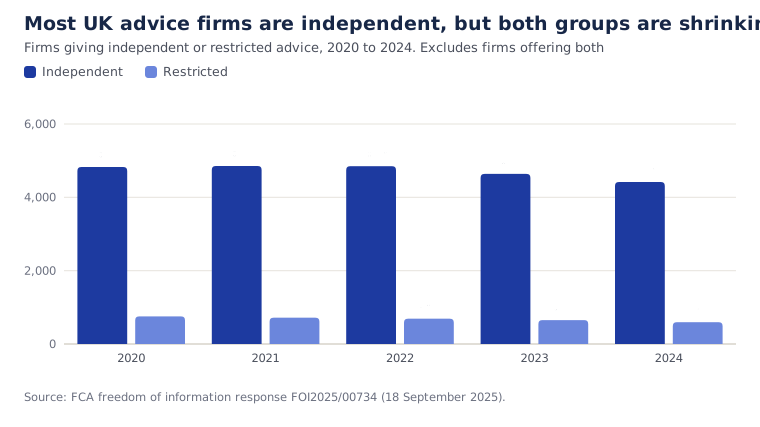
Both have fallen since 2021. FCA figures released under freedom of information (FOI2025/00734, September 2025) show independent firms fell from 4,827 in 2020 to 4,419 in 2024, and restricted firms from 753 to 595, excluding firms that offer both.
Counting firms is not the same as counting advisers. Some restricted firms are very large: St. James's Place reported 4,951 advisers at 30 June 2026. Across the market, the FCA estimates there are around 31,000 financial advisers, and 5,548 UK firms were able to provide advice in 2025 (FCA, Understanding the financial advice market, 23 April 2026).
Is independent advice better than restricted advice?
The rules do not say one is better. Both types of advice can only be given by FCA-authorised firms or their appointed representatives, each recommendation must be suitable for you, and the Consumer Duty applies, which requires firms to deliver good outcomes for retail customers. The difference is the range of products the adviser can consider.
| Points people weigh up | Independent advice | Restricted advice |
|---|---|---|
| Range of products considered | Wider: a sufficient range across the market | Narrower: limited to certain products or providers |
| Fit with a single-product need | Can cover it if the need is within the firm's advice area | Can cover it if the need is within the restriction |
| What the firm must explain about its service | Why its advice is independent | The type and nature of its restriction |
| Written explanation of why a recommendation suits you | Yes (COBS 9 / 9A) | Yes (COBS 9 / 9A) |
| Protection if advice is unsuitable | Financial Ombudsman Service and FSCS | Financial Ombudsman Service and FSCS |
Summary of FCA rules. Information only, not a recommendation.
Do independent advisers cost more?
We have not found recent official FCA data comparing the charges of independent and restricted advisers. Charges vary by firm and by the work involved. Since the Retail Distribution Review came into force on 31 December 2012, advisers of both types must agree their charges with you for advice on retail investment products, such as pensions and investment funds, instead of receiving commission from product providers.
Every adviser must tell you its charges before you commit. Our guide to whether you need a financial adviser sets out typical costs, and our guide to the benefits of using a financial adviser shows how fees affect returns over time.
What protection do you have with each type of adviser?
The same. Complaint rights and compensation do not depend on whether the advice was independent or restricted.
| If something goes wrong | Independent | Restricted |
|---|---|---|
| Complain to the firm, then the Financial Ombudsman Service | Yes | Yes |
| Ombudsman award limit (complaints referred from 1 April 2026, about acts from 1 April 2019) | £455,000 | £455,000 |
| FSCS cover for bad investment advice if the firm has failed | Up to £85,000 per person per firm | Up to £85,000 per person per firm |
Sources: Financial Ombudsman Service award limits; FSCS, what we cover (accessed 21 Oct 2026). Poor investment performance on its own is not covered.
How to check whether an adviser is independent or restricted
- Read the firm's disclosure, which it must give you before advising.
- Ask the adviser directly: "Is your advice independent or restricted, and if restricted, how?"
- Use the FCA Financial Services Register to confirm the firm, or the firm it represents, is authorised, and check the contact details match.
- Check the firm's website and documents for the words "independent advice" or "restricted advice".
How IFA Connect can help
IFA Connect introduces people to independent, FCA-regulated financial advisers. IFA Connect does not give advice itself. A real person listens to what you need and matches you with an adviser from those we have interviewed and vetted. The adviser is responsible for the advice they give you, and our checks do not guarantee the outcome of any advice. Read why IFA Connect only introduces independent advisers.
We typically introduce people with £250,000 or more in investable assets.
Find your local IFA: a real person matches you with one vetted, independent adviser. Our introduction is free; advisers explain their fees before you commit.
Frequently asked questions
What is the difference between independent and restricted financial advice?
An independent adviser must assess a sufficient range of products from across the market, without being limited to products from its own firm or linked providers. A restricted adviser recommends from a limited range of products or providers, or only certain types of product. Both are regulated by the FCA.
What does restricted financial advice mean?
In the FCA's rules, restricted advice is a personal recommendation that is not independent advice. In practice, the adviser may recommend products from one provider, a small panel of providers, or only certain types of product. The firm must explain the nature of the restriction before giving advice.
Is restricted advice worse than independent advice?
Not necessarily. Both types of advice can only be given by FCA-authorised firms or their appointed representatives, and both must be suitable for you. The difference is the range of products the adviser can recommend. Whether that matters depends on what you need advice about.
How do I know if my adviser is independent or restricted?
The firm must tell you before it gives you advice, using the words independent advice or restricted advice, in a durable medium such as paper or email, or on a website if FCA conditions are met. You can also ask the adviser directly, and use the FCA Financial Services Register to confirm the firm is authorised.
Can an independent adviser specialise in one area?
Yes. FCA rules let an independent firm focus on a particular area, such as one type of investment, as long as it markets that service only to clients who want that focus, asks clients to confirm that preference, checks the service suits each new client, and does not present itself as independent in a broader sense.
Is St. James's Place independent or restricted?
St. James's Place's own adviser websites say its Partners represent only St. James's Place Wealth Management plc for the purpose of advising solely on the group's wealth management products and services. Under FCA rules, advice that is not independent is restricted advice. Check the firm's own disclosure for its current status.
Do independent financial advisers cost more?
We have not found recent official FCA data comparing the charges of independent and restricted advisers. Charges vary by firm and by the work involved. Every adviser must tell you its charges before you commit.
Am I protected if I use a restricted adviser?
Yes. Restricted and independent advice are both regulated. You can complain to the firm and then to the Financial Ombudsman Service, which can award up to £455,000 for complaints referred from 1 April 2026 about acts from 1 April 2019. If the firm has failed, the FSCS may pay up to £85,000 per person per firm.
The value of investments and pension income can fall as well as rise. IFA Connect's introduction service is not covered by the Financial Ombudsman Service or the FSCS.