Do I need a financial adviser? For most people in the UK, the honest answer is that it depends on what you are deciding, not on how much you have. Advice is compulsory in only a few situations. In most others, you can choose between doing it yourself, free guidance, a new type of help called targeted support, or paid advice.
This guide sets out when advice is required by law, the situations where people most often use an adviser, what each type of help gives you, and how to check an adviser is regulated. It is information, not a recommendation.
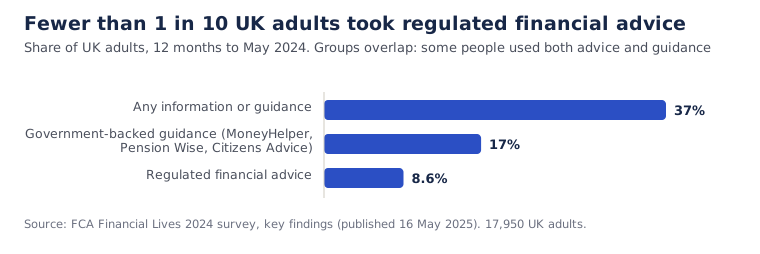
Quick answer: Most people in the UK do not have to use a financial adviser. Regulated advice is only a legal requirement in a few cases, mainly transferring a final salary pension, or giving up other guaranteed pension benefits, worth more than £30,000. Everywhere else it is a choice. In 2024, 8.6% of UK adults took regulated advice, while 37% used information or guidance (FCA).
Key takeaways
- Advice is rarely compulsory. The main legal requirement is for transfers out of final salary (defined benefit) pensions, or other safeguarded benefits, worth more than £30,000.
- Advice and guidance are different. Only advice gives you a personal recommendation. Free guidance services do not give you the same right to complain to the Financial Ombudsman Service or claim from the FSCS.
- Free guidance exists. MoneyHelper and Pension Wise (for people 50+ with a defined contribution pension) explain your options at no cost.
- There is a new middle option. Since 6 April 2026, pension and investment firms can offer FCA "targeted support": suggestions for groups of people in similar circumstances.
- Costs vary widely. Hourly rates typically run from £100 to £350 (MoneyHelper), and some pension schemes let you use up to £500 from your pension to pay for advice, up to three times (no more than once per tax year).
Do I need a financial adviser in the UK?
You do not need a financial adviser to save, invest, use an ISA or take money from most pensions. A financial adviser is useful when you want a personal recommendation: someone who looks at your whole situation, recommends what to do, and is regulated by the Financial Conduct Authority (FCA) for that recommendation.
That is the key difference between advice and guidance. Guidance explains your options without telling you which one to choose. Advice tells you what to do and why, and the adviser is responsible for it being suitable for you.
When is financial advice a legal requirement?
UK law requires regulated advice in a small number of cases. The main one involves pensions with guaranteed benefits.
The £30,000 pension transfer rule
If you want to transfer a defined benefit (final salary) pension, or give up safeguarded benefits such as a guaranteed annuity rate, and the value is more than £30,000, you must take advice from an FCA-authorised firm with permission for 'advising on pension transfers and pension opt-outs'.
You must take the advice, but you do not have to follow it. Some providers may not accept a transfer that goes against the advice. Abridged advice is a shorter first step. It can only recommend that you stay in your scheme, or tell you full advice is needed. It cannot recommend a transfer and does not meet the legal requirement.
Moving one defined contribution pension to another, including into a SIPP, does not legally require advice, unless the pension includes safeguarded benefits such as a guaranteed annuity rate worth more than £30,000. Sources: FCA, Pension transfer advice: what to expect (updated 13 May 2024); Pension Schemes Act 2015, section 48; Pension Schemes Act 2015 (Transitional Provisions and Appropriate Independent Advice) Regulations 2015; The Pensions Regulator, DB to DC transfers and conversions.
When do people usually get a financial adviser?
Outside the legal rule, people tend to look for advice at big moments: retirement, an inheritance, a divorce or a business sale. In a 2025 survey of 8,000 UK adults commissioned by advice firm St James's Place, 44% of people receiving some form of financial advice said a big life milestone was a trigger.
Financial advice vs guidance vs doing it yourself
There are five levels of help, from doing it all yourself to full regulated advice. They differ in how personal the help is, what it costs, and what protection you get if something goes wrong.
| Type of help | What you get | Personal recommendation? | Typical cost | Protection if it goes wrong |
|---|---|---|---|---|
| Doing it yourself | You research and decide | No | Your time, plus platform and fund charges | No advice protection |
| Guidance (MoneyHelper, Pension Wise, Citizens Advice) | Your options explained | No | Free | Not regulated advice; the Ombudsman and FSCS may not apply |
| Targeted support (since 6 April 2026) | Suggestions from your provider for people in similar circumstances | No, not personal to you | Through your pension or investment provider | Given by FCA-authorised firms under FCA rules |
| Simplified advice | A recommendation on one specific need | Yes, limited scope | Can be lower than full advice | Regulated advice: Ombudsman and FSCS can apply |
| Full advice | A recommendation across your whole situation | Yes | Typically £100 to £350 an hour, or a fixed or percentage fee | Regulated advice: Ombudsman and FSCS can apply |
Sources: FCA PS25/22 (targeted support); Citizens Advice, Getting financial advice; MoneyHelper (typical costs).
What is targeted support?
Targeted support is a new type of help the FCA introduced on 6 April 2026. It lets pension and investment firms suggest options designed for groups of customers with similar characteristics, for example people of a similar age with a similar pension who hold a large share of their savings in cash. It is not personalised advice, and the firm does not assess your full circumstances.
The FCA estimates that 23 million people are underserved by the current mix of advice and guidance. Royal London and Quilter were among the first firms approved to offer targeted support in April 2026, and Aviva received approval in June 2026. Sources: FCA policy statement PS25/22 (December 2025); Pensions Age, 9 April and 17 June 2026.
How many people in the UK use a financial adviser?
Fewer than one in ten. The FCA's Financial Lives 2024 survey of 17,950 adults found that 8.6% (4.6 million) took regulated advice on investments, pensions or retirement planning in the 12 months to May 2024. Far more, 37% (20.3 million), used information or guidance, and 17% used government-backed services such as MoneyHelper, Pension Wise or Citizens Advice.
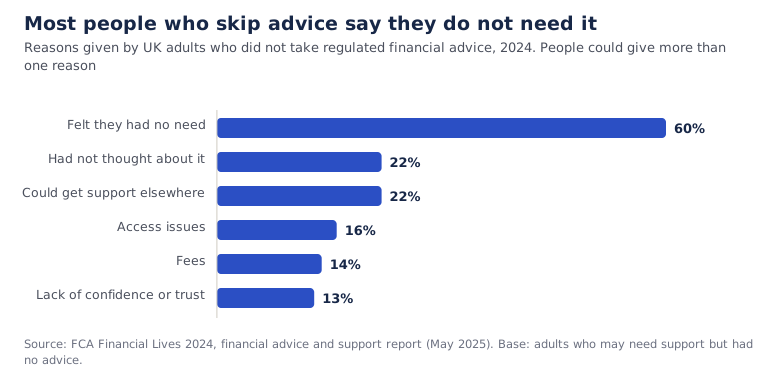
The FCA also found that 29% of adults (15.8 million) had not taken advice but may have needed support, for example because they had £10,000 or more to invest or were close to using their pension. Asked why, 60% of this group said they did not feel they needed an adviser.
Among this group, 68% said they would pay for advice if the cost were reasonable, but only 37% said they had a good understanding of what advice costs.
How much does a financial adviser cost?
Charges vary by adviser, by the size of the job and by how you pay. Advisers must tell you their charges before you commit.
| Type of charge | Typical range |
|---|---|
| Hourly rate | £100 to £350 an hour |
| Average hourly rate | £205 an hour |
| Initial advice on up to £100,000 | £2,000 to £3,000 |
| Ongoing advice | Often 0.5% to 1% a year |
| Pension Advice Allowance | Up to £500 from a defined contribution pension, tax-free, up to three times (no more than once per tax year), if your scheme offers it |
Not every pension scheme offers the Pension Advice Allowance. Fees are examples, not quotes.
Our page on financial adviser fees explains each type of charge and the questions to ask about them.
Is a financial adviser worth it? What the research says
The evidence is mixed and should be read with care. A 2019 study by the International Longevity Centre UK, commissioned by Royal London, found that people who took advice between 2001 and 2006 had on average £47,706 more in pension and other financial wealth about a decade later than similar people who did not. That is an association in older data, not proof that advice caused the difference.
Whether advice is worth it for you depends on the decision, the amount involved, the fee and whether free guidance already answers your question. Our guide to the difference between a wealth manager and an independent financial adviser explains how different firms charge.
Independent or restricted adviser: what is the difference?
An independent financial adviser must consider a wide range of products from across the market, without being limited to particular providers, and give unbiased advice. A restricted adviser recommends from a limited range of products or providers, or specialises in one area. Both are regulated by the FCA. Advisers must tell you which they are. Read more about independent vs restricted financial advice.
How to check a financial adviser is regulated
- Search for the firm and the individual adviser on the FCA Financial Services Register.
- Check the firm has permission for the work you need, for example "advising on pension transfers and pension opt-outs".
- Avoid firms marked "No longer authorised" or "Revoked", and check the phone number and website match the Register to avoid clone firms.
- Ask for the fees in writing before you agree to anything.
| If something goes wrong | Limit |
|---|---|
| Financial Ombudsman Service award limit (complaints about acts on or after 1 April 2019) | £455,000 (from 1 April 2026) |
| FSCS protection for bad investment advice if the firm has failed | £85,000 per person per firm |
Sources: FCA, How to check a firm or individual is authorised; FCA Handbook COMP 10.2.3R; FOS award limits from 1 April 2026. The £85,000 investment limit is separate from the £120,000 limit for bank deposits.
How IFA Connect can help
If you decide you want advice, IFA Connect can introduce you to one independent, FCA-regulated adviser. IFA Connect does not give advice itself. A real person listens to what you need and matches you with an adviser from those we have interviewed and vetted. The adviser is responsible for the advice they give you. See how we vet our advisers.
We typically introduce people with £250,000 or more in investable assets.
For specific decisions, see our guides on how much you need to retire, the 25% tax-free pension lump sum and the inheritance tax threshold.
Find your local IFA: a real person matches you with one vetted, independent adviser. Our introduction is free; advisers explain their fees before you commit.
Frequently asked questions
Do I need a financial adviser?
Not usually. In the UK, regulated advice is only a legal requirement in a few situations, mainly transferring a final salary pension or other guaranteed pension benefits worth more than £30,000. For everything else, using an adviser is a choice. Free guidance from MoneyHelper and Pension Wise can explain your options.
Is financial advice required by law in the UK?
Only in limited cases. If you want to transfer a defined benefit (final salary) pension, or give up safeguarded benefits such as a guaranteed annuity rate, worth more than £30,000, you must take advice from an FCA-authorised adviser. You do not have to follow that advice.
Can I get free financial advice in the UK?
Free personal advice is rare, but free guidance is widely available. MoneyHelper, Pension Wise and Citizens Advice explain your options without recommending products. Some pension schemes also let you take up to £500 tax-free from your pension to pay for advice, up to three times (no more than once per tax year), if your scheme offers it.
What is the difference between financial advice and guidance?
Advice is a personal recommendation based on your circumstances, given by an FCA-regulated adviser. Guidance explains your options without telling you which to choose. Because guidance is not regulated advice, you may not be able to complain to the Financial Ombudsman Service or claim from the FSCS if it goes wrong.
How much does a financial adviser cost in the UK?
Hourly rates typically run from £100 to £350, and Which? reported an average of £205 an hour in 2026. Many advisers charge a fixed or percentage fee for initial advice and often 0.5% to 1% a year for ongoing advice. Advisers must tell you their charges before you commit.
How much money do you need to see a financial adviser?
There is no legal minimum, but many firms set their own. Schroders' adviser surveys found the share of advisers willing to take on new clients with less than £50,000 fell from 52% in 2019 to 25% in 2025.
Do I need a financial adviser for my pension?
Only if you are transferring a final salary pension or other safeguarded benefits worth more than £30,000. For a defined contribution pension, advice is optional. Pension Wise offers free guidance to people aged 50 and over on the ways to take their money.
How do I check a financial adviser is regulated?
Search for the firm and the individual on the FCA Financial Services Register. Check they have permission for the work you need, and that the phone number and website match the Register, to avoid clone firms.
Taking advice does not guarantee a better outcome. The value of investments and pension income can fall as well as rise.