Drawdown and an annuity are the two main ways to turn a defined contribution pension into income. One keeps your money invested. The other swaps it for an income from an insurer.
This guide compares how each works, what each might pay on a £500,000 pot, and how tax and death benefits differ. It is information, not a recommendation.
Quick answer: An annuity pays a guaranteed income, usually for life, and buying one is usually irreversible. Drawdown keeps your pension invested, so income can change and the money can run out; you can usually combine the two. On 5 November 2026, £100,000 at 65 bought about £8,209 a year as a level income (Hargreaves Lansdown).
Key takeaways
- An annuity is a swap. You hand over pension money for a guaranteed income, and the decision is usually irreversible once any cooling-off period ends.
- Drawdown stays invested. You choose what to take, and it can run out if you take too much or live longer than expected.
- Rates are published. On 5 November 2026, £100,000 at 65 bought £8,209 a year level, or £5,641 RPI-linked with a 5-year guarantee (Hargreaves Lansdown).
- The gap shows on £500,000. Drawing £28,205 a year, rising 2.5%, runs out in year 22 at 4% growth and in year 18 at 2% growth.
- Death benefits differ. From 6 April 2027, most unused pension funds count towards your estate, but a single-life annuity that ends at death adds nothing.
What is the difference between drawdown and an annuity?
The main difference is who carries the risk. With an annuity the insurer does, and with drawdown you do. Most of the other differences follow from that.
| Feature | Annuity | Drawdown |
|---|---|---|
| Income | Set when you buy, usually for life | You choose how much and when |
| Who carries the risk | The insurer | You |
| Investment | None on a standard annuity | Your pot stays invested |
| Can it run out? | Not on a lifetime annuity | Yes |
| Changing your mind | Usually irreversible once any cooling-off period ends | You can usually buy an annuity later |
| Inflation | Only protected if you choose a rising income | Depends on growth and what you take |
| Tax-free cash | Usually up to 25%, taken when you buy | Usually up to 25%, at once or in stages |
| Paying in afterwards | A guaranteed lifetime annuity does not usually trigger the £10,000 limit | Taking taxable income cuts the limit to £10,000 a year |
| On your death | Stops, unless you added a joint-life or guarantee option | Unused money can usually pass to beneficiaries |
| If the firm fails | FSCS cover of 100% with no upper cap, where eligible | FSCS cover up to £85,000 per member for investments, where eligible |
Sources: MoneyHelper, flexi-access drawdown; MoneyHelper, MPAA; MoneyHelper, annuities explained; Hargreaves Lansdown, enhanced annuities; FSCS, pensions. Information only.
How does an annuity work?
You exchange some or all of your pension for an income from an insurance company, paid for life or for a set term. Buying one is usually irreversible: after any short cooling-off period, it usually cannot be changed or cancelled.
You set the terms at the start. The main choices are level or rising income, single or joint life, and whether to add a guarantee period.
More people have been buying them. Annuity purchases rose 13.2% to 100,144 in the year to 31 March 2026, according to the FCA.
You do not have to buy from your own provider. Rates differ between insurers, so it pays to compare them, and some older plans carry guaranteed annuity rates that can beat open-market rates.
How does drawdown work?
Drawdown keeps your pension invested while you take money out when you choose. You can usually take up to 25% tax-free, and the rest stays invested, so its value can rise and fall.
The risk sits with you. MoneyHelper says money can run out if you live longer than expected or take too much early. It can also run out if you do not adjust when growth is lower than planned.
It is widely used. In the year to 31 March 2026, 401,137 plans entered drawdown, up 10.5%, and 64.5% of those took a tax-free lump sum (FCA).
Charges come out of the pot too, so they matter over a long retirement. Our page on what advisers charge shows how those costs add up.
What are annuity rates today?
At 65, £100,000 bought a single-life, level income of about £8,209 a year on 5 November 2026, according to Hargreaves Lansdown. Rates change often, and a real quote depends on your age, health and the options you choose.
| Age | Single, level, no guarantee | Single, level, 5-year guarantee | Single, 3% rising, 5-year guarantee | Single, RPI-linked, 5-year guarantee | Joint 50%, level, no guarantee |
|---|---|---|---|---|---|
| 55 | £7,057 | £7,036 | £4,955 | £4,485 | £6,695 |
| 60 | £7,414 | £7,386 | £5,336 | £4,921 | £7,081 |
| 65 | £8,209 | £8,145 | £6,093 | £5,641 | £7,624 |
| 70 | £8,996 | £8,881 | £6,913 | £6,446 | £8,331 |
| 75 | £10,208 | £9,948 | £8,094 | £7,648 | £9,143 |
Source: Hargreaves Lansdown, best annuity rates, quoted 5 November 2026, £100,000 purchase, annual income, joint life assuming a spouse three years younger.
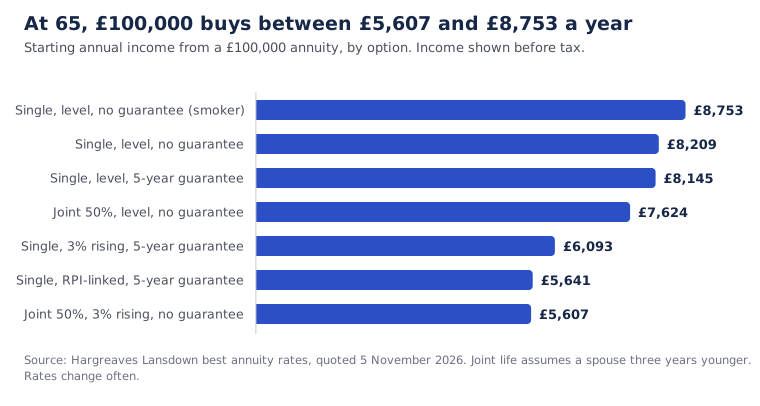
On £500,000, the age-65 figures scale to about £41,045 level or £28,205 RPI-linked with a 5-year guarantee. Scaling is our assumption, and larger purchases can be quoted differently.
If £125,000 is taken tax-free first, the remaining £375,000 buys about £30,784 level or £21,154 RPI-linked on the same rates.
How long could £500,000 last in drawdown compared with an annuity?
On these assumptions, £500,000 in drawdown paying the same starting income as an RPI-linked annuity runs out in year 22 at 4% growth. A lifetime annuity would keep paying for life.
Assumptions: a £500,000 pot at age 65, growth of 2%, 4% or 6% a year, and withdrawals taken at the end of each year. Withdrawals rise 2.5% a year for inflation unless shown as level, and all figures are before tax and charges. The pot runs out in the first year it cannot pay the full amount.
| Drawdown withdrawal from £500,000 | 2% growth | 4% growth | 6% growth |
|---|---|---|---|
| £28,205 a year, rising 2.5% | Runs out in year 18 | Runs out in year 22 | Runs out in year 29 |
| £41,045 a year, rising 2.5% | Runs out in year 13 | Runs out in year 14 | Runs out in year 17 |
| £41,045 a year, level | Runs out in year 15 | Runs out in year 18 | Runs out in year 23 |
Source: IFA Connect calculation, using Hargreaves Lansdown age-65 rates of 5 November 2026 for the starting incomes. An illustration only, not a forecast.
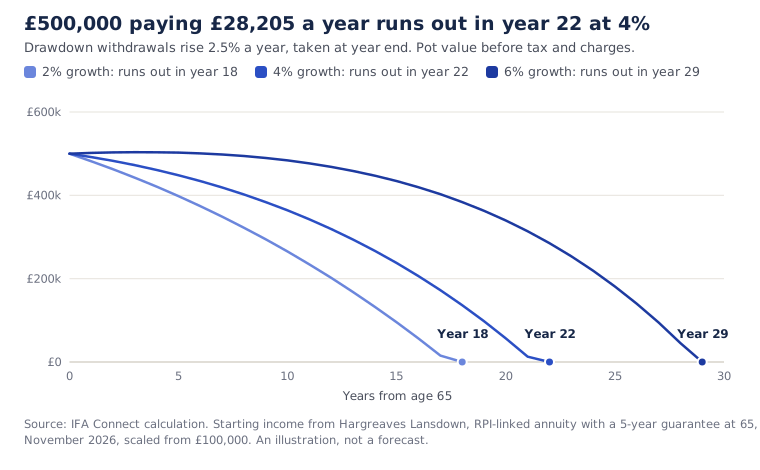
Other levels of withdrawal are covered in our guide to how much you need to retire, which uses the same method.
Longevity is the other half of the sum. The ONS projects that a woman aged 65 in 2024 can expect another 22.7 years on average, and a man 20.0 years. An average also means many people live longer.
A level income loses buying power over time. If inflation averaged 2.5%, £41,045 in 20 years' time would buy what £25,049 buys today.
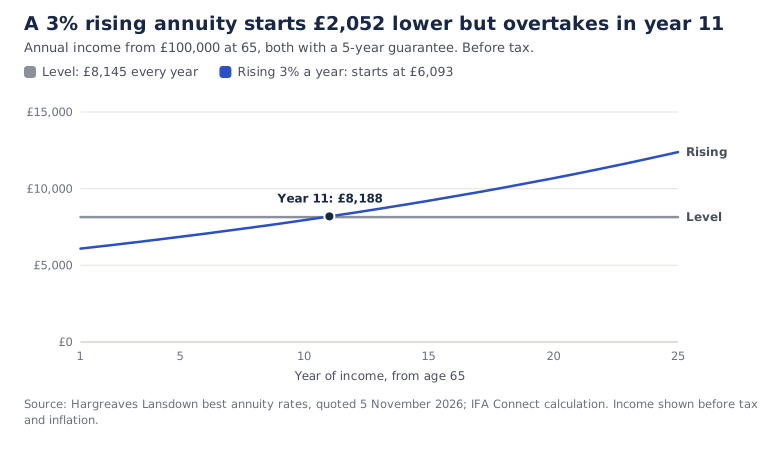
A 3% rising annuity starts £2,052 lower per £100,000 than a level one. It overtakes the level income in year 11 and has paid more in total by year 20.
How is each one taxed?
Both are taxed as income, apart from any tax-free cash. You can usually take 25% of your pension tax-free, up to £268,275 across all your pensions (GOV.UK).
| Point | Annuity | Drawdown |
|---|---|---|
| Tax-free cash | Usually up to 25%, taken when you buy | Usually up to 25%, at once or in stages |
| Lump sum allowance | £268,275 across all your pensions, for most people | £268,275 across all your pensions, for most people |
| Income tax | Payments count as income for tax | Withdrawals count as income in each tax year |
| Money purchase annual allowance | A guaranteed lifetime annuity does not usually trigger it | Taking taxable income cuts the limit from £60,000 to £10,000 a year |
| First payment | Most providers deduct tax through PAYE before paying you | A first flexible withdrawal is usually taxed on an emergency code, month 1 basis. Forms P55, P50Z and P53Z reclaim any overpayment |
Sources: GOV.UK, tax-free amounts; GOV.UK, how your tax is paid; MoneyHelper, MPAA; HMRC, PAYE94055; GOV.UK, pension tax refunds; Budget 2026, rates and allowances.
The Budget on 28 October 2026 left the £268,275 and £10,000 figures unchanged for 2026/27 and 2027/28. Our guide to how the 25% tax-free lump sum works covers the cash itself, including emergency tax.
The £10,000 limit matters if you are still paying into a pension. Our complete pension guide explains how it works alongside the wider annual allowance.
Can you mix drawdown and an annuity?
Yes, you can usually combine them. MoneyHelper says you can usually choose more than one way to take your pension, and a different option for each pot.
One illustration splits £500,000 in half at 65. £250,000 buys an RPI-linked annuity of about £14,102 a year on the rates above. The other £250,000 stays in drawdown paying £14,102 a year, rising 2.5%.
On the same assumptions, the drawdown half runs out in year 22 at 4% growth. The annuity half keeps paying. With a full State Pension of £12,547.60, that is about £26,650 a year at today's starting figures, before tax.
Buying later is another form of mixing. Hargreaves Lansdown's quote at 75 was £10,208 per £100,000, about 24% more than at 65. No one knows what rates will be then, or what the pot will be worth.
What is a health-enhanced annuity?
A health-enhanced annuity pays more if your health or lifestyle suggests a shorter life expectancy. Each provider sets its own criteria, and you answer medical and lifestyle questions to qualify (MoneyHelper).
Hargreaves Lansdown quoted £8,753 a year on £100,000 for a smoker at 65, against £8,209 for its standard profile. That is £544 more, or about 6.6%, for 10 cigarettes a day for 20 years and 15 units of alcohol a week.
Common qualifying conditions include high blood pressure, diabetes and stroke, usually without a medical (Hargreaves Lansdown). Quotes depend on accurate details, because inaccurate information can change or withdraw the rate.
What happens to each when you die?
An annuity usually stops at death unless you added a joint-life or guarantee option, while unused drawdown money can pass on. From 6 April 2027, the two also differ for inheritance tax.
| Point | Annuity | Drawdown |
|---|---|---|
| On your death | A single-life annuity with no guarantee ends. A joint-life annuity continues to your partner. A guarantee can keep payments going for a set period | Unused money can usually pass to the people you nominate |
| Inheritance tax from 6 April 2027 | A single-life annuity that ends at death adds £0 to the estate. A dependant's or nominee's annuity bought with your lifetime annuity is excluded. Payments continuing for a guarantee period can count | Unused funds count towards your estate |
| Income tax if you die before 75 | Income from survivors' annuities is usually tax-free | Beneficiaries' income from drawdown is usually tax-free |
| Income tax if you die at 75 or over | Taxed as the beneficiary's income | Taxed as the beneficiary's income |
| Spouse or civil partner | Exempt from inheritance tax | Exempt from inheritance tax |
Sources: HMRC, technical note on inheritance tax and pensions; HMRC, technical note 2; HMRC, policy paper; MoneyHelper.
Inheritance tax rates, allowances and who pays are set out in our guide to pensions and inheritance tax from 2027.
Who tends to weigh which?
People usually weigh the same few factors differently. These are general patterns, not a recommendation, and most people's answer touches more than one row.
| Factor | People who tend to weigh an annuity | People who tend to weigh drawdown |
|---|---|---|
| Essential bills | Want guaranteed income to cover them | Already cover them with State Pension or defined benefit income |
| Investment risk | Prefer not to depend on markets | Are comfortable with ups and downs |
| Health | Have a condition that may lift the rate | Want money kept accessible if health changes |
| Family | Want a partner's income protected | Want unused money to pass on, after allowing for the April 2027 change |
| Flexibility | Prefer a fixed income and fewer decisions | Want to vary income from year to year |
| Time and interest | Would rather not manage investments | Are willing to review regularly or pay for help |
IFA Connect summary of the factors above. Information only.
Guidance or advice: what helps with this choice?
Pension Wise, from MoneyHelper, gives free, impartial guidance to people aged 50 or over with a defined contribution pension. It explains your options but does not recommend one.
Regulated advice is personal. An adviser can help you decide whether an annuity, drawdown or a mix fits your income needs, health and family. Our page on retiring with £500,000 or more covers that work, and the complete retirement guide sets this choice in context.
How IFA Connect can help
IFA Connect is an introducer and does not give advice itself. A real person speaks to each enquirer and introduces one vetted, independent, FCA-regulated adviser, and that adviser gives the advice.
We typically introduce people with £250,000 or more in investable assets. Read more about independent retirement advice and how an introduction works.
Find your local IFA: a real person matches you with one vetted, independent adviser. Our introduction is free; advisers explain their fees before you commit.
Frequently asked questions
Is drawdown better than an annuity?
Neither is better for everyone. A lifetime annuity gives an income that cannot run out, while drawdown gives flexibility with investment risk. An adviser can help you decide whether one, the other or a mix fits your circumstances.
Can you switch from drawdown to an annuity later?
Yes, money in drawdown can usually be used to buy an annuity later. Going the other way is not usually possible, because buying an annuity is usually irreversible once any cooling-off period ends.
Can you cancel an annuity after buying it?
Usually only during a short cooling-off period. After that, an annuity usually cannot be changed or cancelled, even if your circumstances change. Quotes are also only guaranteed for a limited time.
How much income does £500,000 buy as an annuity at 65?
Scaling Hargreaves Lansdown's quotes of 5 November 2026 gives about £41,045 a year level, or about £28,205 RPI-linked with a 5-year guarantee. Both are before tax, and your own quote will depend on your age, health and options.
Does drawdown trigger the money purchase annual allowance?
Taking taxable income from drawdown triggers it, cutting the contribution limit from £60,000 to £10,000 a year. Taking only tax-free cash, or buying a guaranteed lifetime annuity, does not usually trigger it.
Is annuity income taxed?
Yes. Annuity income counts as income for tax, on top of your other income in the year. Most pension providers deduct the tax through PAYE before paying you.
What happens to an annuity when you die?
It depends on the options chosen. A single-life annuity with no guarantee ends when you die. A joint-life annuity continues to a partner, and a guarantee can keep payments going for a set period.
The value of investments and pension income can fall as well as rise, and you may get back less than you put in. Tax rules can change and their effect depends on your circumstances. IFA Connect's introduction service is not covered by the Financial Ombudsman Service or the FSCS.