An IFA is an independent financial adviser: a qualified professional who looks at your whole financial picture and makes personal recommendations on pensions, investments and retirement income. Independent has a specific meaning in UK rules. It is about how wide a range of products the adviser can recommend.
This guide explains what an IFA does, what they can advise on, how they are qualified and paid, and how to check one. It is information, not a recommendation.
Quick answer: An IFA (independent financial adviser) is a qualified, FCA-regulated professional who gives personal recommendations on pensions, investments and retirement income. To call its advice independent, a firm must assess a sufficient range of products from across the market, not only its own or linked providers. IFAs charge agreed fees and must tell you the cost before you commit.
Key takeaways
- IFA means independent financial adviser. The word independent is defined by Financial Conduct Authority (FCA) rules, so a firm cannot simply choose to use it.
- Most advice firms are independent. In 2024, 87% of firms giving retail investment advice gave independent advice (FCA).
- Retirement is the main reason people go. It was the primary objective for 69% of advice firms' retail clients in the FCA's 2025 survey.
- Advisers must stay qualified. The minimum is a Level 4 qualification, plus a Statement of Professional Standing renewed every year and at least 35 hours of learning a year.
- You have protection. You can complain to the Financial Ombudsman Service, and the FSCS can pay up to £85,000 for bad investment advice if the firm has failed.
What does IFA mean?
IFA stands for independent financial adviser. You may also see it spelt independent financial advisor, which means the same thing.
Under FCA rules, a firm that says its advice is independent must assess a sufficient range of relevant products on the market. That range must be diverse in type and provider, and must not be limited to products from the firm itself or firms closely linked to it.
Advice that does not meet this standard is restricted. Restricted does not mean worse, because all advice must be suitable for you. The difference is the range of products the adviser can recommend. An individual adviser cannot give both kinds of advice, and the firm must tell you which you are getting before it advises you. Our guide to independent vs restricted advice covers the rules in detail.
Job titles are less precise. Financial adviser, financial planner and wealth manager are often used for similar work, so it is worth looking past the title. See wealth manager or independent financial adviser for how those two compare.
What does an IFA actually do?
An IFA turns your circumstances into a written recommendation, then helps you put it in place. The product usually comes last. Most relationships follow these steps.
- A first conversation. You explain what you want to sort out, and the adviser explains their service and likely cost. Many advisers offer this first meeting free.
- A fact find. The adviser collects details of your income, pensions, savings, debts, family and goals.
- A risk assessment. They look at how much risk you are comfortable with and how much loss you could afford.
- Research and planning. They compare options and, for retirement, often model how long your money may last.
- A written recommendation. You receive a report explaining what is recommended and why it suits you.
- Putting it in place. If you agree, the adviser arranges the pensions, investments or policies.
- Reviews, if you want them. In the FCA's 2025 survey, 88% of retail clients received ongoing advice. Ask what is included and how to stop it.
What can an IFA advise on?
Most IFAs cover pensions, retirement income and investments. Some areas need extra qualifications or permissions, so it is worth checking the firm covers what you need.
| Area | What an IFA can help with | Worth checking |
|---|---|---|
| Pensions | Reviewing and combining pensions, contributions, tax-free cash | Whether an old pension has guarantees you could lose |
| Retirement income | Drawdown, annuities, how long your money may last | Whether ongoing reviews are included |
| Investing | ISAs, funds and portfolios, investing a lump sum | All charges, including platform and fund costs |
| Inheritance tax and estate planning | Gifting, trusts, pensions and the April 2027 changes | The FCA does not regulate tax planning, trusts or will writing |
| Life events | Selling a business, an inheritance, divorce | Experience of situations like yours |
| Protection | Life cover, income protection | Whether the adviser is paid by commission on these products |
| Final salary pension transfers | Advice is required by law if the benefits are worth more than £30,000 | The firm needs specific permission and a pension transfer specialist |
| Equity release | Advice is required before you take it out | The adviser needs a specialist qualification |
Sources: MoneyHelper, how to choose a financial adviser; FCA, pension transfer advice.
Retirement is the main reason people go to an IFA. In the FCA's 2025 survey of advice firms, it was the main objective for 69% of retail clients.
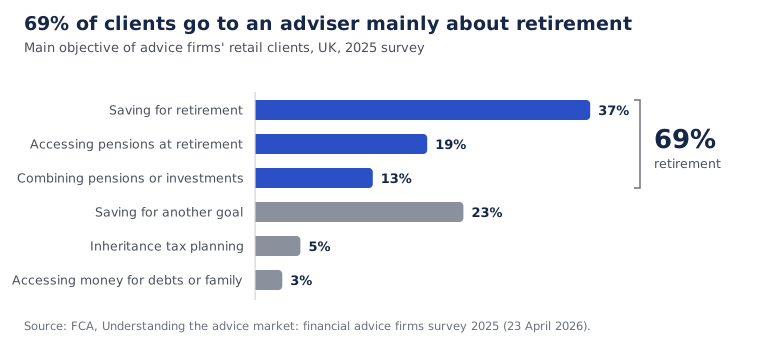
Inheritance tax planning was the main objective for only 5% of clients. From April 2027, most unused pensions will count towards the estate, as our guide to pensions and inheritance tax from 2027 explains.
How is an IFA different from other financial help?
The main difference is how personal the help is. An IFA gives a recommendation for you alone, while guidance and targeted support do not.
| Type of help | What you get | Personal to you? | Typical cost | Who provides it |
|---|---|---|---|---|
| Independent advice | A recommendation from a sufficient range of products across the market | Yes, based on a full review | Agreed fee | FCA-authorised firms |
| Restricted advice | A recommendation from a limited range of products or providers | Yes, within that range | Agreed fee | FCA-authorised firms |
| Targeted support (since 6 April 2026) | Suggestions made to groups of customers with similar circumstances | No, based on people like you | Often free | Authorised firms with this permission |
| Guidance | General information about your options, with no recommendation | No | Free | MoneyHelper, including Pension Wise for over-50s with a defined contribution pension |
Sources: FCA, Advice Guidance Boundary Review; FSCS, what we cover. Information only.
You do not always need an adviser. Our guide to whether you need a financial adviser sets out when advice is required by law and when it is a choice.
What qualifications does an IFA need?
Every adviser on pensions and investments must hold at least a Level 4 qualification and renew a Statement of Professional Standing each year. These are FCA requirements, and they apply to independent and restricted advisers alike.
| Requirement | What it means | Required? |
|---|---|---|
| Level 4 qualification | The minimum for advice on pensions and investments, such as the DipFA or the Diploma in Regulated Financial Planning | Yes |
| Statement of Professional Standing | A certificate from an accredited body, valid for up to 12 months, confirming qualifications and ethical standards | Yes |
| Continuing professional development | At least 35 hours a year, of which 21 must be structured learning | Yes |
| Chartered or Certified Financial Planner status | Higher qualifications taken voluntarily | No |
Source: FCA, professional standards for advisers.
You can ask an adviser to show you their Statement of Professional Standing. It is a simple request, and a good adviser will not mind it.
How are IFAs regulated, and what protection do you have?
An IFA must work for a firm authorised by the FCA, or act as an appointed representative of one. You can check either on the Financial Services Register.
If you are unhappy with advice, you complain to the firm first, then to the Financial Ombudsman Service, which is free. It can award up to £455,000 for complaints referred from 1 April 2026 about events on or after 1 April 2019.
If the firm has failed, the Financial Services Compensation Scheme (FSCS) can pay up to £85,000 per person, per firm, for bad investment advice. Poor investment performance on its own is not covered. If your adviser is an appointed representative, ask who the principal firm is, because you may not be covered for work the principal did not allow.
How do IFAs get paid?
IFAs agree their charges with you. Since 31 December 2012, advisers on retail investments such as pensions and funds cannot take commission from product providers for that advice. Commission can still apply to some protection products.
Which? reports an average of £205 an hour in 2026, and an FCA figure of about 0.8% a year for ongoing advice. Our financial adviser fees page shows how those charges add up. The FCA's 2025 survey found a typical adviser has about 150 clients, with around £250,000 of assets and £2,000 of revenue per client.
Who uses an IFA, and are there IFAs near you?
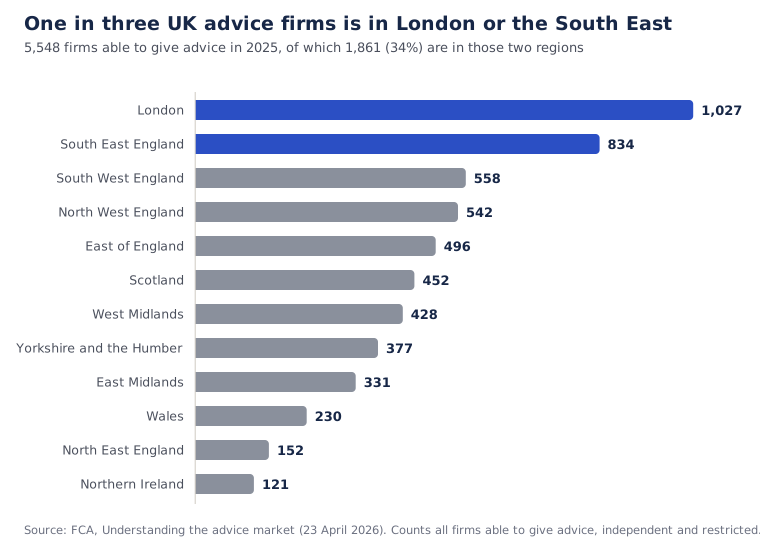
Around 9% of UK adults, about 4.6 million people, took regulated financial advice in the 12 months to May 2024 (FCA). The FCA counts around 31,000 advisers and 5,548 firms able to give advice in 2025, across every UK region.
You do not need to be very wealthy to use an IFA, but some advisers set a minimum. MoneyHelper gives £50,000 or £100,000 as examples, so it is worth asking early. In the FCA's 2025 survey, 99% of small and medium firms and all large firms said they meet clients face to face.
How can you check an IFA is genuine?
Four checks take a few minutes and answer most of the risk.
- Search the Financial Services Register for the firm and adviser, and check the contact details match.
- Ask whether the advice is independent or restricted, and ask for it in writing.
- Ask to see the adviser's Statement of Professional Standing.
- Ask what you will pay, in pounds, at the start and each year.
Our guide to how to choose a financial adviser turns these checks into 10 questions, with what a good answer sounds like.
How IFA Connect can help
IFA Connect introduces people to independent, FCA-regulated financial advisers. IFA Connect does not give advice itself. A real person listens to what you need and matches you with an adviser from those we have interviewed and vetted. The adviser is responsible for the advice they give you, and our checks do not guarantee the outcome of any advice. See how we vet our advisers.
Read why IFA Connect only introduces independent advisers.
We typically introduce people with £250,000 or more in investable assets.
Find your local IFA: a real person matches you with one vetted, independent adviser. Our introduction is free; advisers explain their fees before you commit.
Frequently asked questions
What does IFA stand for?
IFA stands for independent financial adviser. Under FCA rules, independent means the firm must assess a sufficient range of products from across the market, and must not be limited to its own or closely linked providers.
What is the difference between an IFA and a financial adviser?
An IFA is one type of financial adviser. Financial advisers give either independent or restricted advice. An independent adviser assesses a sufficient range of products across the market, while a restricted adviser recommends from a limited range. Both are regulated by the FCA.
Is an IFA the same as a wealth manager?
Not always. Wealth manager is a job description, while independent is a term defined in FCA rules. Some wealth managers give independent advice and others give restricted advice, so ask which applies before you go ahead.
Are IFAs regulated in the UK?
Yes. An IFA must work for a firm authorised by the FCA, or act as an appointed representative of one. You can check both on the Financial Services Register. Complaints can go to the Financial Ombudsman Service.
How much does an IFA cost?
Which? reports an average of £205 an hour in 2026, and an FCA figure of about 0.8% a year for ongoing advice. An IFA must tell you the charges before you commit, and many offer a free first conversation.
Do I need a lot of money to use an IFA?
Not necessarily, but some advisers set a minimum, such as £50,000 or £100,000 to invest. Others will advise on any amount. It is worth asking about minimums and whether the adviser works with people in a similar position to you.
Can an IFA help with inheritance tax?
Yes, many IFAs help with inheritance tax planning, including gifts, trusts and pensions. The FCA does not regulate tax planning, trusts or will writing, so ask how the firm handles that work and whether a solicitor or accountant will be involved.
The value of investments and pension income can fall as well as rise, and you may get back less than you put in. Tax rules can change and their effect depends on your circumstances. The Financial Conduct Authority does not regulate tax planning, trusts or will writing. IFA Connect's introduction service is not covered by the Financial Ombudsman Service or the FSCS.