Many people choose a financial adviser on a recommendation or a good first impression. Both are useful. Neither tells you whether a firm is genuine, properly qualified or worth what it charges.
This guide gives you 10 questions to ask any adviser, with what a good answer sounds like and the red flag to watch for. If you are still deciding whether you need a financial adviser at all, start there. It is information, not a recommendation.
Quick answer: To choose a financial adviser, check them on the Financial Services Register, then ask two or three advisers the same 10 questions. Ask about independence, qualifications, experience with people like you, total cost in pounds, ongoing service and your protection. Get the answers in writing before you commit.
Key takeaways
- Check before you meet. Search the Financial Conduct Authority's (FCA) Financial Services Register or Firm Checker, and use the contact details shown there, not those you were given.
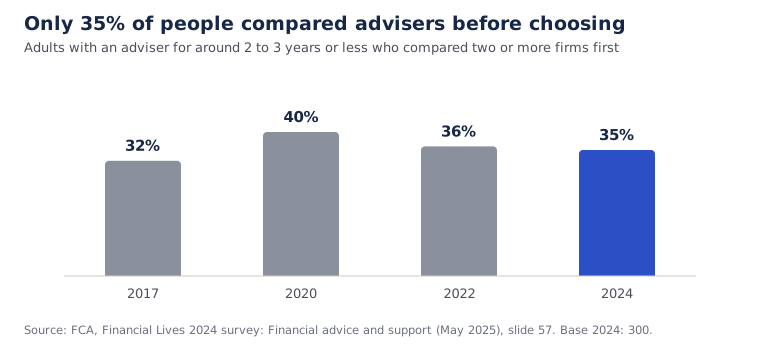
- Few people compare. Only 35% of adults with a recent adviser compared two or more firms before choosing, in the FCA's 2024 survey.
- Ask for pounds, not percentages. An adviser must state charges before taking you on, and should be able to indicate what you are likely to pay.
- Ongoing fees need a written service. The FCA found promised reviews were delivered in about 83% of cases at 22 large firms, so ask what you get.
- You have protection, with limits. The Financial Ombudsman Service can award up to £455,000 on recent cases. The FSCS can pay up to £85,000 if a firm has failed.
How do you choose a financial adviser?
Choose in three stages: decide what you need, check who is genuine, then compare two or three advisers on the same questions. MoneyHelper starts in the same place, with the type of advice you actually need.
- Write down what you need help with. Pensions, retirement income, investing a lump sum or something more specialist each point to different skills.
- Build a short list of two or three names. A recommendation from someone you trust is a reasonable place to start.
- Run the checks and meet them. Many advisers offer a free first meeting, so use it to test the answers below.
Comparing matters, but few people do it. The FCA's Financial Lives 2024 survey asked people with an adviser of around two to three years or less whether they compared firms first. Only 35% had.
Among those who did not compare, the most common reason was that the adviser had been recommended. Which? suggests getting quotes from at least three advisers.
Of those who did compare, only 17% said it was difficult. If you are still weighing up whether advice is worth paying for, see the benefits and trade-offs of advice.
What are the 10 questions to ask a financial adviser?
These 10 questions cover who the adviser is, what they can do, what you will pay and what happens if things go wrong. Questions 1 to 5 can be settled before you meet. Questions 6 to 10 are for the meeting itself.
1. Is your firm on the FCA Register?
A genuine firm will be on the FCA's Financial Services Register, with permission for the advice you want. The FCA's Firm Checker is a simpler way to search firms.
Compare the phone number, address and web address with those you were given. Fraudsters copy real firms' names and reference numbers, then change small details.
Good answer: Here is our firm reference number. Please check it and call us on the number shown.
Red flag: You are told the Register entry is out of date. The FCA says that is unlikely, because its records update about every 24 hours. Call it on 0800 111 6768.
2. Are you personally on the Register?
Your adviser should be named on the Financial Services Register, which lists individuals as well as firms. The Firm Checker does not cover individuals, so use the Register to see current roles and any disciplinary action.
Advisers must also hold a Statement of Professional Standing from an accredited body, valid for up to 12 months. They must complete at least 35 hours of learning a year.
Good answer: Yes, and here is my current Statement of Professional Standing with my reference number.
Red flag: The name is not on the Register, the statement has expired, or you are told it does not matter.
3. Is your advice independent or restricted?
Every firm should be able to tell you which it is, in one sentence. An independent adviser can offer products from across the market, while a restricted adviser recommends only certain products or providers. The FCA says a restricted adviser can still be a good choice, so the point is knowing the range you are getting.
Our guide to independent vs restricted advice covers the rules, and what is an IFA? explains what an independent adviser does. Job titles do not settle it, as wealth manager or independent financial adviser shows.
Good answer: One plain answer, confirmed in writing, and how they choose from that range.
Red flag: We are basically independent, or no clear answer on which providers they use.
4. Are you an appointed representative?
Some advisers are appointed representatives, which means they advise on behalf of a principal firm. The FCA counts 6,610 appointed representatives across 340 advice firms, so this is a routine question.
You may not be protected if a representative acts beyond what the principal allows. Ask for the principal's contact details and what they cover.
Good answer: No, we are directly authorised. Or: yes, our principal is this firm, and this is what we may do.
Red flag: They cannot name the principal, or they offer a service the principal does not cover.
5. What qualifications do you hold?
Every adviser needs at least a Level 4 qualification for advice on pensions and investments, so ask what they hold above that. Many hold higher qualifications such as Chartered or Certified Financial Planner, and a properly qualified adviser should be happy to show you their certificates.
Some work needs more. By law, you must take advice before transferring a defined benefit pension worth over £30,000, and the firm needs a specific permission. Equity release advisers need a specialist qualification.
Good answer: They name each qualification, show the certificate and say plainly if your need is outside what they do.
Red flag: Long experience is offered instead of a named qualification, or a specialist job is taken on without the permission.
6. How many people like me do you advise?
A good adviser can describe people like you without naming anyone. The FCA's 2025 survey suggests a typical adviser has about 150 clients, with around £250,000 of assets each. Ask how much attention you would get, and whether there is a minimum amount they work with.
Good answer: Recent examples of similar decisions, and honesty about the cases they pass on.
Red flag: They suggest an answer before hearing your circumstances, or have never handled your main concern.
7. What will I pay in pounds?
An adviser must tell you the charges before taking you on, and should be able to indicate what you are likely to pay. Ask for the full cost in pounds, including platform and fund charges, not only a percentage. Our page on what financial advisers charge shows how the fees work.
Good answer: A written figure in pounds for the first year and each later year, split by who receives it.
Red flag: It comes out of your pot, so you will not notice it. Advisers on pensions and investments cannot take commission, so you are paying either way.
8. What do I get each year, and how do I stop it?
You should get a defined service, with reviews you can expect and a clear way to leave. In the FCA's 2025 survey, 88% of retail clients received ongoing advice.
When the FCA reviewed 22 of the largest firms, promised reviews were delivered in about 83% of cases. Clients declined or did not respond in a further 15%, and in fewer than 2% the firm had not tried.
Ask who carries out the review and who takes over if your adviser retires. The average adviser is in their late 40s, and the FCA says succession planning in small family firms is commonly informal.
Good answer: A written service showing what a review covers, when it happens, who does it, the yearly cost and how to cancel.
Red flag: We are always here if you need us, with nothing in writing and a fee that carries on regardless.
9. Will you put your recommendation in writing?
Yes: a regulated adviser should give you a personalised report setting out what they recommend and why. For pension transfers, the FCA expects a suitability report that explains the reasoning.
Read it before you sign. The FCA says a genuine business should be willing to let you take time to decide.
Good answer: A written report before anything is put in place, and as long as you need to read it.
Red flag: A deadline to act, a product suggested before your circumstances are known, or a promised return.
10. How am I protected if things go wrong?
You are protected by the Financial Ombudsman Service and, if a firm fails, the Financial Services Compensation Scheme (FSCS).
Complain to the firm first, which usually has up to 8 weeks to respond. You then have 6 months from its final response to go to the Ombudsman, which is free. It can award up to £455,000 for complaints referred from 1 April 2026 about events on or after 1 April 2019.
If the firm has failed, the FSCS can pay up to £85,000 per person, per firm, for bad investment advice. Poor investment performance on its own is not covered.
Good answer: They explain both routes and give you the firm's complaints procedure in writing.
Red flag: A recommendation to put money into something unregulated, such as wine, diamonds or overseas land. The FCA warns you may have no protection.
What do people check when they compare advisers?
Fees come first, and only about half of those comparing look at the Register. In the FCA's 2024 survey, 59% of people comparing advisers looked at fees and 53% at the Financial Services Register. Qualifications and the type of advice were each checked by 46%.
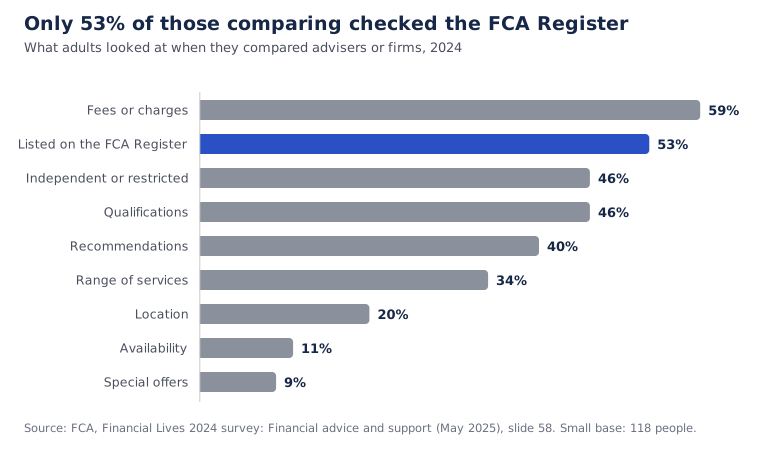
The Register check takes a few minutes, and it comes first on this list for that reason.
How can you check the answers you are given?
Most answers can be tested against a document or a public record, so you do not have to rely on how convincing someone sounds. Keep a simple note for each adviser you speak to.
| Question | Where to check it | What to keep |
|---|---|---|
| 1. Firm on the Register | FCA Firm Checker or Financial Services Register | Firm reference number and the number you called |
| 2. Adviser on the Register | Financial Services Register, Statement of Professional Standing | A copy of the statement |
| 3. Independent or restricted | The firm's written description of its service | That written confirmation |
| 4. Appointed representative | Financial Services Register, which lists representatives and principals | The principal's name and contact details |
| 5. Qualifications | Certificates, and the firm's permissions on the Register | A note of each qualification |
| 6. People like you | Examples from the adviser, without names | Your notes from the meeting |
| 7. Cost in pounds | A written figure from the adviser | The figure for the first year and later years |
| 8. Ongoing service | The client agreement | The review schedule and how to cancel |
| 9. Written recommendation | The personalised or suitability report | The report itself |
| 10. Protection | The firm's complaints procedure, and the Ombudsman and FSCS websites | The complaints details |
Sources: FCA, Financial Services Register; MoneyHelper, how to choose a financial adviser; FCA, ongoing advice review.
How do you find a financial adviser you can trust?
You find an adviser you can trust by looking for evidence you can check, not only a good first impression. In the FCA's 2024 survey, 24% of adults who might need advice disagreed that advisers act in their clients' best interests. Among people who had taken advice, 53% reported high trust in their adviser.
Whether you search for a financial adviser or a financial advisor, the checks are the same. A recommendation is a fair place to start, but it is hard to judge in the short term how good a job an adviser has done.
Some services vet advisers before introducing you, and you can read the seven steps behind our own vetting. Vetting does not replace your own checks.
How IFA Connect can help
IFA Connect introduces people to independent, FCA-regulated financial advisers. IFA Connect does not give advice itself. A real person speaks to each enquirer and introduces one vetted, independent adviser.
Our vetting requires advisers to be FCA regulated and hold at least a Level 4 Diploma in Financial Planning. They must also be able to advise across the whole market. We also check each adviser's history, reviews and client feedback.
The adviser is responsible for the advice they give you, and our checks do not guarantee the outcome of any advice. The 10 questions above apply just as much to an adviser we introduce. See how we vet our advisers.
Read why IFA Connect only introduces independent advisers.
We typically introduce people with £250,000 or more in investable assets.
Advisers pay to be part of the network, and you never pay IFA Connect.
Find your local IFA: a real person matches you with one vetted, independent adviser. Our introduction is free; advisers explain their fees before you commit.
Frequently asked questions
How do I choose a financial adviser?
Decide what you need, check the firm and adviser on the Financial Services Register, then compare two or three advisers on the same questions. Ask about independence, qualifications, experience, total cost in pounds, ongoing service and your protection.
How do I find a financial adviser I can trust?
Look for evidence you can check. Check the firm and adviser on the Register, see a current Statement of Professional Standing, and get the cost and service in writing. A recommendation is a good start, but it is not proof.
What questions should I ask a financial adviser at the first meeting?
Ask whether the advice is independent or restricted, what qualifications they hold and how many people like you they advise. Ask what you will pay in pounds, what the ongoing service includes and how you are protected. MoneyHelper says advisers often offer a free first meeting.
How can I check a financial adviser is genuine?
Search the FCA's Firm Checker or Financial Services Register, then compare the contact details with those you were given. If they differ, or none are listed, call the FCA on 0800 111 6768 before you share anything.
How many financial advisers should I speak to?
Two or three is usually enough to compare answers and costs. In the FCA's 2024 survey, only 35% of adults with a recent adviser compared two or more firms before choosing. Which? suggests getting quotes from at least three advisers.
What qualifications should a financial adviser have?
At least a Level 4 qualification for advice on pensions and investments, plus a current Statement of Professional Standing. Some hold higher qualifications such as Chartered or Certified Financial Planner. Defined benefit transfers and equity release need specialist permissions or qualifications.
What happens if my adviser gives me bad advice?
Complain to the firm first. If it does not resolve the matter within 8 weeks, you can go to the Financial Ombudsman Service, which is free. If the firm has failed, the FSCS can pay up to £85,000 per person, per firm, for bad investment advice.
The value of investments and pension income can fall as well as rise, and you may get back less than you put in. IFA Connect's introduction service is not covered by the Financial Ombudsman Service or the FSCS.